



Citrine Crystal Guide: meaning, origin & properties
For steady forward motion.
Learn what Citrine is, where ours comes from, traditional associations across cultures, and how to identify a real specimen, in our complete Citrine Crystal Guide.
Only 1 left in stock
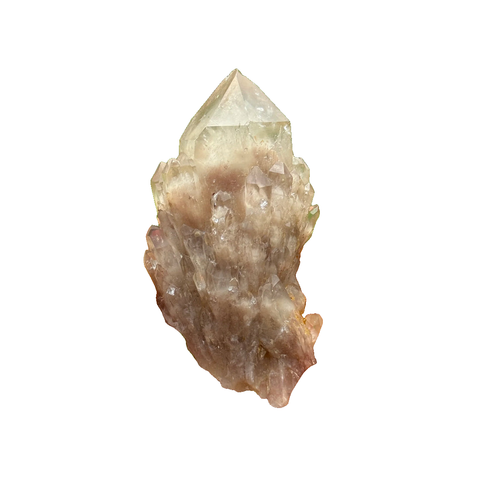
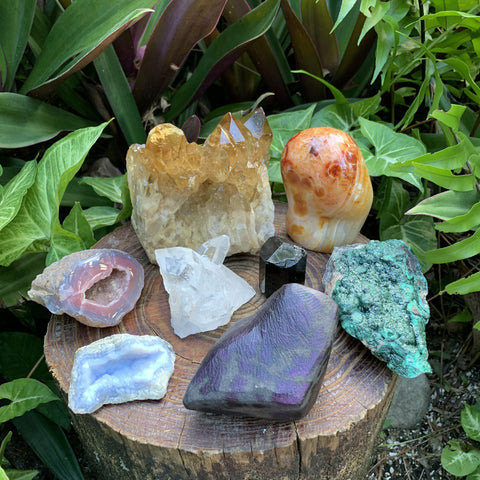
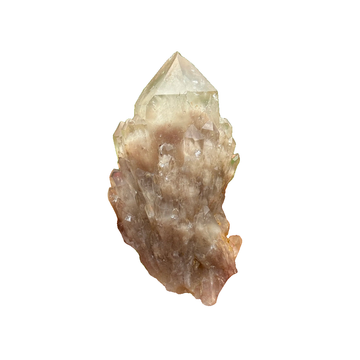
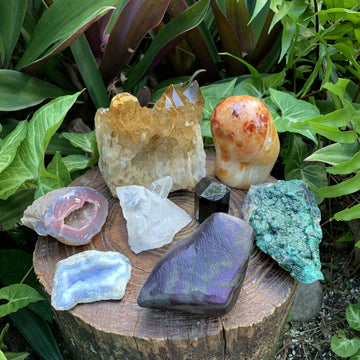
This is an A-grade Natural Citrine raw crystal cluster from Haut-Lomami, DR Congo. Natural citrine is colored by trace iron as it grew, never heat-treated, unlike the baked amethyst sold under the same name. Chunky through the middle and upright at 2.53 inches, heavy for its footprint. It measures 2.19 x 1.69 x 2.53 inches, 0.41 pounds, Mohs 7, jojoba-finished and otherwise untreated.
Natural citrine is quartz that grew yellow. Trace iron in the crystal lattice produces a soft honey to pale amber color, sometimes with smoky gray or lavender zoning running through the same piece. It is not the bright orange most shops sell.
That matters, because most citrine on the world market is heat-treated amethyst. Baking amethyst turns it a uniform saturated orange, often with a white base. Genuine natural citrine is paler, softer, and less even. The muted color is the tell.
This cluster came out of pegmatite-hosted quartz veins in Haut-Lomami, Democratic Republic of the Congo, through a community partnership. It is hand-finished with natural jojoba oil and nothing else.
Citrine is worked with around abundance, confidence, and creative momentum, the kind that shows up as steady follow-through rather than a burst. It is traditionally linked to the solar plexus and crown chakras.
If that resonates, a cluster like this usually lives on a desk or workspace shelf where you pass it during the day.
These are traditional associations drawn from historical practice. This stone is not a substitute for medical or mental health care.
Offered as a starting point for your own practice.
Natural Citrine sits at 7 on the Mohs scale, harder than a steel blade, so it handles daily carry and a quick rinse without fuss. The one thing that hurts it is sunlight: months in a bright window will fade the color, and it does not come back.
Natural natural citrine from Haut-Lomami, Democratic Republic of the Congo. Natural. Most citrine sold worldwide is heat-treated amethyst, which produces a uniform bright orange. This is genuinely yellow quartz from the ground, which is why the color is softer and less even.
Yes. This listing is one piece, photographed individually. When it sells, it is gone.
It measures 2.19" L x 1.69" W x 2.53" H and weighs 0.41 pounds.
Grades reflect visual quality within a batch. A is standard, with typical inclusions. AA shows stronger color, cleaner surfaces and tighter sizing. AAA is the top 10 to 15 percent of a batch. Every lot is inspected and graded by our team in Rockville, Maryland, not taken on the supplier’s word.
Haut-Lomami, Democratic Republic of the Congo, from pegmatite-hosted quartz veins, through a community partnership. It came to us through a community partnership, one of the sourcing models we publish and stand behind.
Every lot is inspected and graded by our expert team before it is listed, not taken on the supplier's word. A on this listing means stronger color, cleaner surfaces and tighter sizing than the batch average. Pieces that miss the mark never reach the shop.
How We GradeSourced through a regional cooperative or community-based workshop. Processing and economic benefit stay local, which means more of the value reaches the people doing the work. We say what we know and where our tracing stops.
Our Sourcing StandardsEverything we sell is natural in origin: never synthetic, never dyed, never coated. Where a stone has been heated, irradiated or stabilized, which is common in the trade for some species, we say so on the listing. If a piece is not as described, return it within 90 days of delivery.
Returns and GuaranteeA one-of-a-kind piece sells once, so it rarely has reviews of its own. These are verified reviews of other Beyond Bohemian orders, not of this piece.