





What "conflict-free" really means for a crystal
A reassuring promise with real limits, and usually no certificate behind it.
A crystal labeled "conflict-free" looks like a guarantee. The trouble is that the phrase was borrowed from the diamond world, where it means something specific, and very little of what gives it weight there carries over to the stone you are holding.

Conflict-free means a stone has not helped fund armed conflict. For diamonds, that claim is backed by a global scheme called the Kimberley Process. For crystals and colored stones there is no equivalent, so the label is unregulated and rests on a seller's word. It is also narrow, because a conflict-free stone can still involve unfair pay or environmental harm.
A phrase the diamond trade built
The idea of a "conflict-free" stone grew out of the campaign against blood diamonds in the late 1990s, when rough diamonds were funding brutal civil wars. The response was the Kimberley Process, a global certification scheme launched in 2003 that tries to keep conflict diamonds out of the legitimate market.
Its definition is deliberately narrow. The Kimberley Process treats a conflict diamond as a rough diamond used by rebel movements to finance wars against recognized governments. It also applies only to rough stones. Once a diamond is cut and polished, the certificate stops following it.
On its own terms, the scheme is vast. It covers nearly every diamond-producing country on earth.
the year the Kimberley Process began certifying rough diamonds
countries represented by its members
share of the world's rough diamond production its members account for
Source: the Kimberley Process, the diamond industry's certification scheme.
None of that machinery reaches your crystal
Here is the part most labels skip. The Kimberley Process covers diamonds, and only diamonds. There is no equivalent certification for amethyst, quartz, labradorite, or any of the colored stones that fill a crystal shop. The scheme that gives "conflict-free" its teeth for diamonds simply does not exist for crystals.
Other certifications do not fill the gap. Fairtrade and Fairmined standards are real and respected, but they cover gold and a few metals, not gemstones or crystals. So when a crystal seller prints "conflict-free," no outside body is checking the claim.
Part of the reason is the shape of the trade. Around 80% of colored stones are dug by hand in artisanal and small-scale mines, the kind worked by individuals and families rather than large companies. Small-scale mining supports tens of millions of people worldwide, second only to farming as a rural livelihood, which makes it both vital and very hard to formally certify. One major source, Madagascar, shows how tangled this gets, so we cover it on its own.

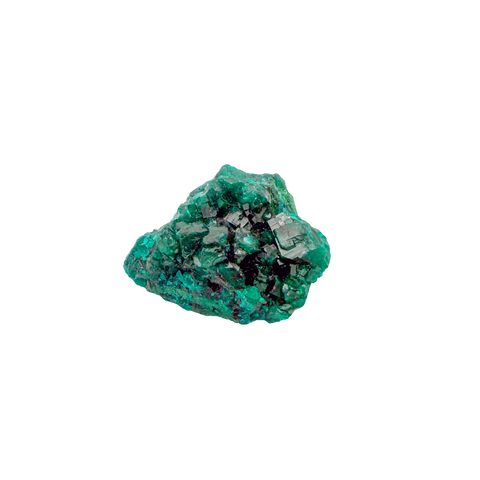
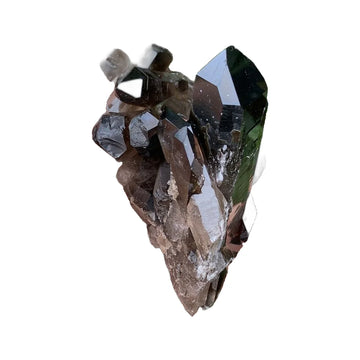
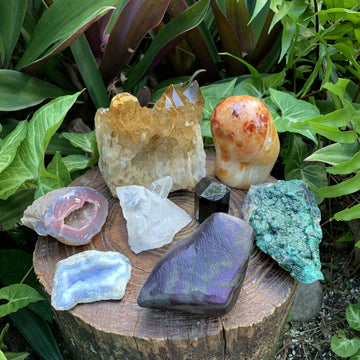
Raw fluorite from Namibia. Most colored stones begin like this, hand-dug in small-scale mines that no certificate tracks.
Conflict-free is not the same as ethical

Polished malachite, a copper mineral. Its mining raises labor and environmental questions a conflict-free label was never designed to answer.
Even where the term is backed, it answers one question and one only: did this stone help pay for a war? It says nothing about how the people who mined it were treated, what the digging did to the land, or whether anyone was paid fairly.
That narrowness has drawn steady criticism. In 2011, Global Witness, one of the groups that helped create the Kimberley Process, walked away from it, arguing the scheme ignored violence and abuses that fell outside its rebel-financing definition. The certificate does not address state-led violence, child or forced labor, smuggling, or anything that happens to a stone after it leaves its country of origin.
The logic runs one direction. A stone that is genuinely ethically sourced will, almost by definition, also be conflict-free. The reverse is not true. A crystal can be perfectly conflict-free and still have been mined in unsafe conditions, for poverty wages, with real damage to the surrounding land.
"A conflict-free stamp answers one question. It is not the whole conscience of a stone."
The sourcing words, side by side
Sourcing labels get used loosely, and several of them are quietly doing different jobs. Here is what each one claims, what stands behind it, and where it goes quiet.
Conflict-free
A war-financing claim
Ethically sourced
A broad, undefined claim
Fair trade / Fairmined
A certified metals claim
Traceable / known origin
A named-source claim
Conflict mineral (legal term)
A regulated 3TG category
A crystal is not a "conflict mineral" in the legal sense
It is easy to assume "conflict-free crystal" is a legal category the way conflict-free diamond can feel like one. It is not. The term "conflict mineral" has a precise legal meaning, and crystals are not in it.
Under the US Dodd-Frank Act, and a parallel European Union regulation, "conflict minerals" refers to exactly four materials: tin, tantalum, tungsten, and gold, often shortened to 3TG. These are the metals most tied to financing armed groups in central Africa. Quartz, agate, amethyst, and the rest of the crystal shelf are not on that list.
That distinction cuts both ways. Being outside the law is not the same as being harm-free. It simply means no regulation is watching, which puts the responsibility back on the seller to know their supply chain and on the buyer to ask.

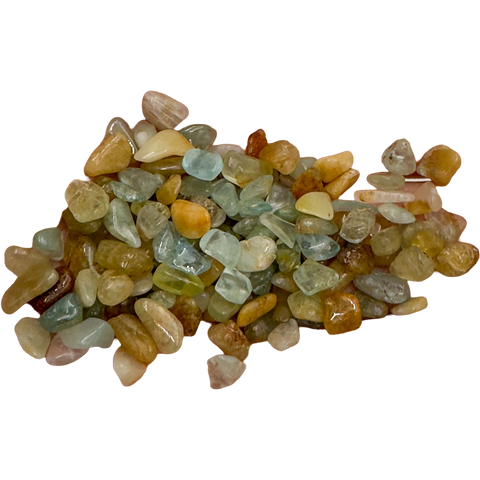
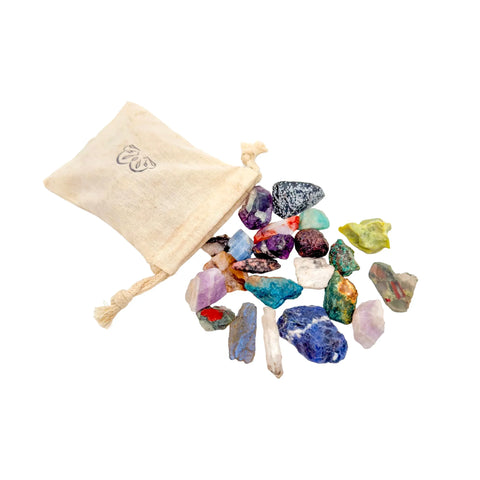
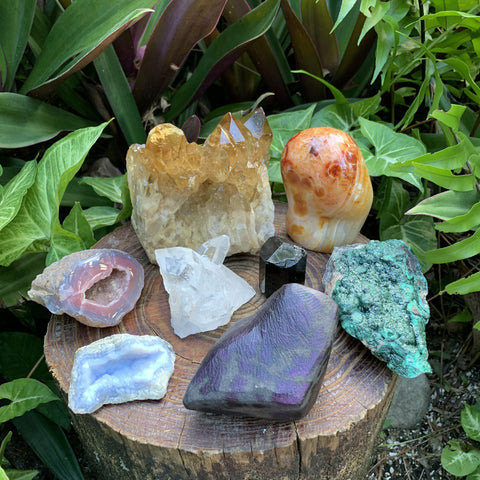
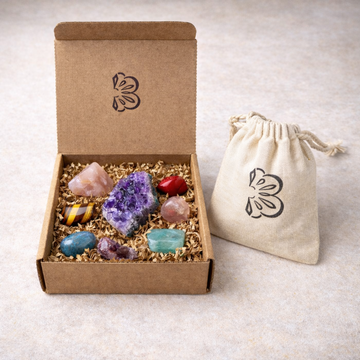
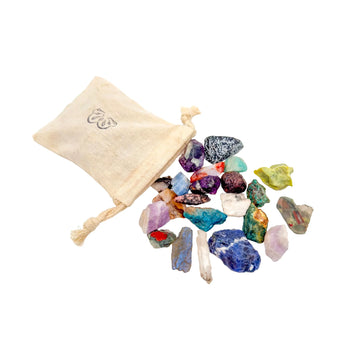
A typical crystal mix. None of these stones fall under the legal conflict mineral rules, which cover only four metals.
For crystals, "conflict-free" is a value statement, not a legal status. It is only as trustworthy as the person making it, which is why the detail behind the claim matters more than the claim.
What a claim worth trusting looks like

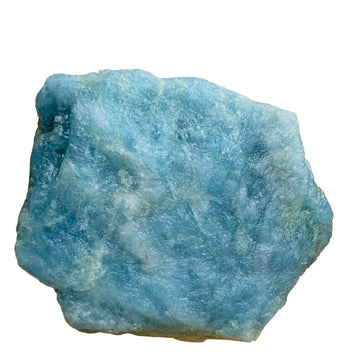
Raw larimar, found in commercial quantity only in the Dominican Republic. A rare case where origin is genuinely easy to name.
If a certificate cannot back the word, something else has to. In practice, that something is specifics. The most trustworthy sellers trade slogans for detail: which stones, from which country, bought from whom, and where their knowledge runs out.
Real traceability is possible for some stones. A handful of initiatives, such as Moyo Gems in East Africa, follow specific colored stones from named women miners to market and pay them several times the usual rate, sometimes recording each step on a blockchain. These programs are encouraging, but they cover particular stones and supply chains, not the whole crystal market.
Larimar is a useful example of genuinely known origin: it is found in commercial quantity in only one place on earth, the Dominican Republic, so its source is rarely in doubt. Most stones are not so simple, which is exactly why honesty about the gaps matters more than a confident label.
A real answer names specific stones and origins, not a blanket "ethically sourced" stamped on everything.
Ask how close to the source the seller buys, and whether they know their supplier by name.
An honest seller will tell you where the record ends rather than invent a tidy origin.
We would rather be specific than slick. We describe what we know about a stone, name a source when we can, and say so plainly when a history cannot be verified. You can read our twelve sourcing standards and our Beyond Ethical approach for the full picture.
Keep going
A few guides that pick up where this one leaves off.
A country-level case study of one of the trade's biggest and most scrutinized sources.
Read the guideThe specific, non-negotiable checks behind what we choose to sell.
See the standardsHow we think about sourcing beyond any single label or slogan.
Read our approachA buyer's checklist for telling real detail from a polished phrase.
Use the checklistOur full set of plain, trustworthy guides to sourcing, treatment, and care.
Browse the LibraryFrequently asked
What does "conflict-free" mean for crystals?
It means the stone has not helped fund armed conflict, such as a war financed by selling rough gems. For diamonds that claim is backed by the Kimberley Process. For crystals there is no equivalent scheme, so the phrase is unregulated and depends entirely on the seller's honesty.
Is there a Kimberley Process for crystals or colored stones?
No. The Kimberley Process covers rough diamonds only, and stops once a diamond is cut. There is no equivalent certification for crystals or colored gemstones, and Fairtrade and Fairmined cover gold and some metals rather than stones.
Does conflict-free mean a crystal is ethically sourced?
Not necessarily. Conflict-free answers a single question: did the stone fund a war? It says nothing about fair wages, safe working conditions, or environmental damage. A genuinely ethically sourced stone would also be conflict-free, but a conflict-free stone is not automatically ethical.
Are crystals considered conflict minerals?
Not in the legal sense. Under the US Dodd-Frank Act and a parallel EU regulation, conflict minerals means only tin, tantalum, tungsten, and gold, known as 3TG. Quartz and colored stones are not on that list, which also means no law is monitoring how they are mined.
Can a crystal be certified conflict-free?
There is no official certificate to earn. Because no scheme governs crystals, any conflict-free or ethically sourced wording is the seller's own claim, not a third-party verification. That is why specifics, like named sources and supplier relationships, matter more than the label itself.
Why is conflict-free so hard to verify for crystals?
Most colored stones pass through many hands, and rough is mixed into bulk lots that blur where any single piece came from. Around 80% are dug by hand in small-scale mines that keep few records. By the time a stone reaches a shop, its full history is often genuinely unknown.
Are fair trade crystals real?
Mostly not in a certified sense. Fairtrade and Fairmined certification exist, but they apply to gold and certain metals, not gemstones or crystals. A few traceability programs, such as Moyo Gems, follow specific stones from named miners to market, but they cover particular supply chains rather than the whole market.
What should I look for instead of a conflict-free label?
Look for detail rather than slogans. Ask which stones come from which countries, how close to the source the seller buys, and what they cannot trace. A specific, honest answer, including admitting gaps, is a stronger sign than a polished phrase with nothing behind it.