
















Crystal Inclusions Explained: The Needles, Gardens, and Ghosts Inside Quartz
The threads, scenes, and faint shadows held in a clear stone are not flaws. They are the record of how it grew.
Hold a clear quartz to the light and you might find golden needles, a tiny mossy landscape, or a second crystal floating inside. Those are inclusions, and they are some of the most misread features in the whole crystal world.

A crystal inclusion is any material, another mineral, a gas, or a drop of liquid, that was trapped inside a host crystal while it grew. In quartz, the usual ones are rutile and tourmaline needles, chlorite gardens, phantom layers, and dendrites. Most are natural, and on quartz they often add value rather than lower it.
What an Inclusion Actually Is
An inclusion is something that was trapped inside a crystal while that crystal was forming. It can be another mineral, a bubble of gas, or a pocket of liquid. The key word is inside. An inclusion grew into the stone and was sealed under later layers of crystal. It is not dirt on the surface, not a chip, and not damage from handling.
Quartz is the host you meet most often, for a simple reason. It is usually clear or close to it, and it grows slowly in spaces shared with other minerals. As the quartz builds layer by layer, whatever sits in its path, a slender rutile needle, a dusting of chlorite, a thread of black tourmaline, gets wrapped in and held in place. The result is a window into a moment of the stone's growth.
Here is a field guide to the inclusions you are most likely to meet, what each one is, and how it got there.
Rutile
Titanium dioxide needles
Tourmaline
Black schorl rods
Chlorite (garden / lodolite)
Green mineral scenes
Phantom
Ghost of an earlier shape
Dendrite
Branching oxides
Hematite
Iron oxide plates
Fluid / enhydro
Trapped liquid pocket
Negative crystal
Crystal-shaped void
Notice the pattern. Almost every one of these formed at the same time as the stone, which is why an inclusion is better understood as part of a crystal's story than as a fault in it. The same slow, layered growth also builds a geode.
Needles, Gardens, and Dendrites
Most inclusions fall into three looks that are easy to learn. Once you can tell them apart by eye, the names start to make sense.
The first is metallic needles. Golden threads are rutile, a titanium dioxide that forms fine, straight or gently curving lines. Black rods are usually schorl, the dark tourmaline. Both are prized in quartz, and good needles can make a piece more desirable, not less.
The second is the included scene, sold as garden quartz, lodolite, or scenic quartz. These are clear quartz crystals carrying chlorite and other minerals that settle into mossy, layered pictures. No two are alike, which is most of their appeal.
The third is the dendrite, the fern or tree pattern in stones like dendritic agate. It looks alive, but it is not, and that is one of the most common misunderstandings in the whole subject.

Rutilated quartz. The golden lines are rutile, a titanium dioxide, sealed in as the quartz grew around them.

Garden quartz, also called lodolite. Chlorite and other minerals form the layered, landscape-like scene.

Dendritic agate. The branching pattern is iron and manganese oxide, not a plant or a fossil.
The fern inside dendritic agate fools almost everyone. It is not a fossilized plant and was never alive. The pattern is made of iron and manganese oxides that crept into fine cracks and crystallized in a branching shape, which is why geologists call it a pseudofossil. Our dendritic agate guide shows more examples.
Phantoms: A Crystal That Recorded Its Own Pauses
A phantom is a faint crystal shape floating inside a larger crystal, and it forms in one of the most elegant ways in mineralogy. While the quartz was growing, something interrupted it: a shift in temperature, pressure, or the fluid feeding it. During that pause, a thin layer of mineral dust, often chlorite, hematite, or fine clay, settled onto the crystal's faces.
When growth started again, the quartz sealed that dusty layer under fresh, clear crystal. What remains is a ghost outline marking exactly where the crystal stopped and started. If the stone paused several times, you can see a stack of phantoms, each one a separate chapter in its growth.

Amethyst phantoms from Zambia. Each faint inner outline marks a pause in the crystal's growth, sealed under later layers.
Trapped Water, and the Inclusions That Aren't
A few features look like inclusions but belong in their own category. Knowing the difference saves you from both needless worry and a bad purchase.
An enhydro holds a pocket of liquid sealed in as the crystal grew, sometimes with a tiny bubble that drifts when you tilt the stone. This is a genuine fluid inclusion, and a stable one. The water can be extremely old.
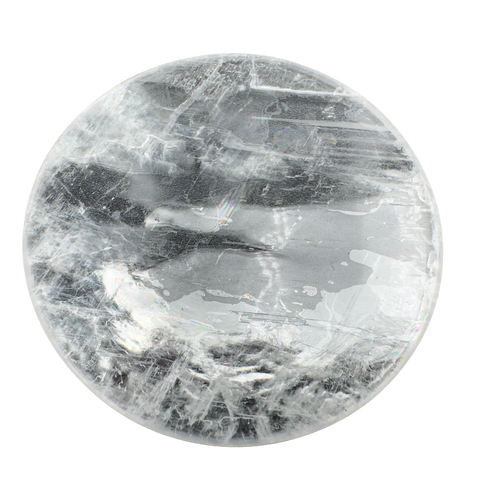
The flashes of color inside some clear quartz are not a trapped material at all. They are light bouncing off an internal fracture and splitting into a spectrum, the way a soap film shows color. Common, natural, and not a defect. Our durability guide covers what fractures do and do not mean.
A negative crystal looks like a tiny crystal suspended inside the stone, but it is actually an empty, faceted cavity. The hollow simply took on the same shape as its host. It is space, not substance.
If you remember one thing, let it be this. A true inclusion is a thing that is present inside the stone. A rainbow is an effect of light, and a negative crystal is an absence. All three are natural, and none of them is a flaw.
Real Stone or Glass, and Does It Lower the Value?

Raw rutilated quartz from Brazil. Natural needles sit at different depths and angles, exactly what a glass imitation cannot copy.
Because included quartz is popular, it is also imitated. The good news is that the inclusions themselves give the fakes away. Natural needles are irregular and three dimensional. They sit at different depths inside the stone and point in slightly different directions, because they grew that way. Glass imitations tend to hold uniform fibers lined up flat on a single plane, and glass almost always traps round air bubbles, which natural quartz does not.
Two quick checks help. Real quartz is a hard stone, a 7 on the Mohs scale, so it stays cool to the touch and resists scratching. Glass warms quickly in the hand and scratches more easily. Lab-grown quartz with added inclusions also exists, and while it is real quartz, an honest seller will tell you it is created rather than natural.
Now the question everyone asks. Do inclusions lower a crystal's value? For a faceted diamond or sapphire, clarity is everything, and an inclusion usually counts against it. Included quartz turns that rule upside down. The rutile, the tourmaline, the garden scene is the whole point, and the finest examples, with crisp, even, well-colored inclusions, command the highest prices. For more on what sets price, see crystal grades explained.
A flaw in a diamond can be the whole point in quartz. Same word, opposite meaning.
Every included piece we list is described for what it is: the kind of inclusion, the stone it sits in, and where we know it came from. A garden quartz is a garden quartz, named plainly, so you can see exactly what you are choosing.
Go Deeper
The host that carries most inclusions, from rutile needles to phantoms.
Read the guideA closer look at the branching patterns that are mineral, not plant.
See the patternsThe slow, layered growth that also builds phantoms and gardens.
Read the geologyWhat internal fractures and rainbows mean for a stone's strength.
Check durabilityRutilated, tourmalinated, garden, and phantom pieces, described plainly.
Browse included quartzBrowse every Beyond Bohemian guide to sourcing, value, and care.
Back to the LibraryCrystal Inclusions FAQ
What are the lines or threads inside my quartz?
They are inclusions, most often needles of rutile (golden or red) or black tourmaline (schorl) that were sealed inside as the quartz grew. Fine straight or crisscrossing lines are normal and natural, and on quartz they are usually considered desirable rather than a flaw.
Do inclusions make a crystal worth less?
For faceted gems like diamonds, inclusions lower value because clarity is prized. For included quartz, the opposite is true. The rutile, tourmaline, or garden scene is the appeal, and the cleanest, most evenly patterned pieces are the most valuable.
What is the difference between rutilated and tourmalinated quartz?
Rutilated quartz holds needles of rutile, a titanium dioxide that is usually golden, copper, or red. Tourmalinated quartz holds rods of black tourmaline (schorl). Both look like needles in clear quartz, but they are different minerals and different colors.
Is garden quartz the same as lodolite?
Yes. Garden quartz, lodolite, and scenic quartz are all names for clear quartz filled with chlorite and other minerals that form landscape-like scenes. The names describe the same kind of included stone.
Are the rainbows inside my crystal an inclusion?
No. A rainbow inside clear quartz is light reflecting off an internal fracture and splitting into colors, not a trapped mineral. It is common, natural, and not a sign of damage or a fake.
Is the tree or moss inside dendritic agate a plant or a fossil?
Neither. The branching pattern is made of iron and manganese oxides that crept into fine cracks and crystallized. It only looks organic, which is why it is called a pseudofossil. Nothing inside was ever alive.
How can I tell natural included quartz from glass with fake needles?
Natural needles are irregular and sit at different depths and angles. Glass imitations show uniform fibers on one flat plane and usually trap round air bubbles. Quartz is also harder and stays cool, while glass warms quickly in the hand.
Are the black needles in tourmalinated quartz safe to handle?
Yes. The tourmaline is sealed inside solid quartz, and the stone is stable and inert to handle. Normal handling, displaying, and wearing pose no issue.