





How a Geode Forms, From an Empty Pocket to a Vault of Crystals
Every geode is a two-step story: first the hollow, then the slow fill.
A geode looks like a plain lump of rock until it is opened to reveal a glittering cavity. Getting there takes two separate geological events, usually set far apart in time.

A geode forms in two stages. First a cavity opens inside rock, a gas bubble trapped in cooling lava or a void left in sediment. Later, silica-rich groundwater seeps in and lines the walls, building inward as chalcedony and quartz crystals over thousands to millions of years.
Two Things Every Geode Needs
A geode is not made in one event. It needs a hollow space to fill, and it needs mineral-rich water to do the filling. Those two things can be separated by enormous stretches of time, which is part of why a finished geode can feel like such an unlikely object.
The cavity comes first. It can form in cooling lava or in soft sediment, and the way it forms shapes the geode that follows. Once the void exists, water carrying dissolved silica does the patient work, one thin layer at a time, until crystals line the inside.
A void forms inside solid rock. In lava it is a gas bubble sealed in as the rock cools. In sediment it is a space left where a soluble mineral, a buried root, or a shell dissolved away.
Water seeping through the surrounding rock picks up dissolved silica, the raw material of quartz, then reaches the empty pocket and begins to deposit it.
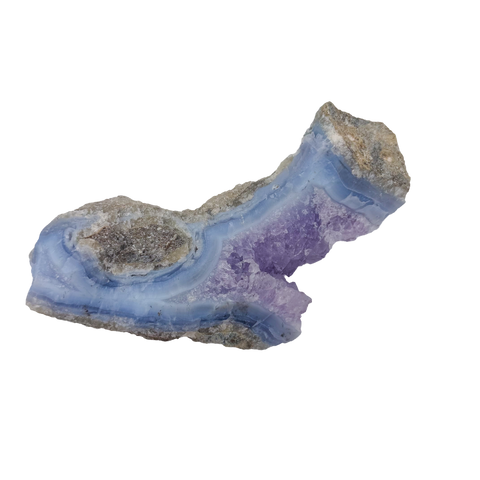
The earliest silica settles as chalcedony, a microcrystalline quartz that coats the cavity wall. As the chemistry shifts, it can build up in fine bands, which is how agate forms.
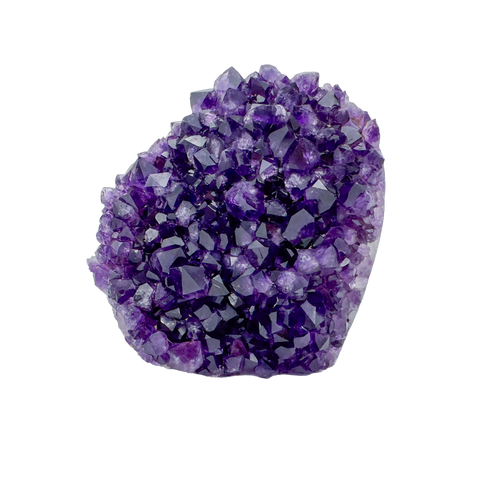
With the wall sealed, larger, well formed crystals grow toward the open center. Where iron and natural radiation act on the quartz, those crystals can become amethyst.
The geode sits buried for a very long time. Eventually weathering frees it from the host rock, or a saw or hammer opens it to show the cavity inside.
Where the Hollow Comes From
Geodes form in two very different settings, and the host rock is the first clue to a geode's history. In volcanic rock, the hollow usually starts as a gas bubble. As lava cools, dissolved gases try to escape, and the rock sometimes hardens around them before they reach the surface, trapping a rounded void called a vesicle.
In sedimentary rock, the hollow forms differently. Acidic groundwater can dissolve part of a soluble rock such as limestone or gypsum. A void can also be left behind when buried organic matter, a root or a shell, decays, or when a mud concretion forms around an organic core that later dissolves.

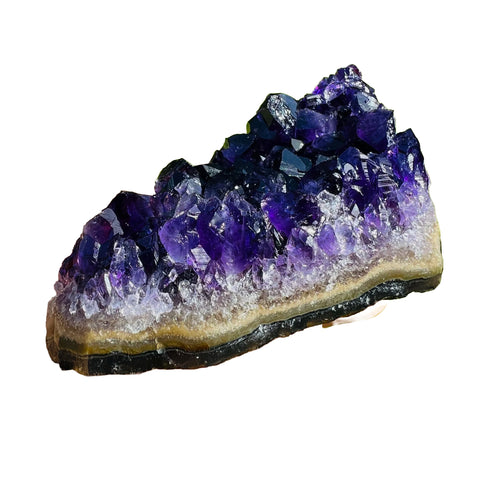
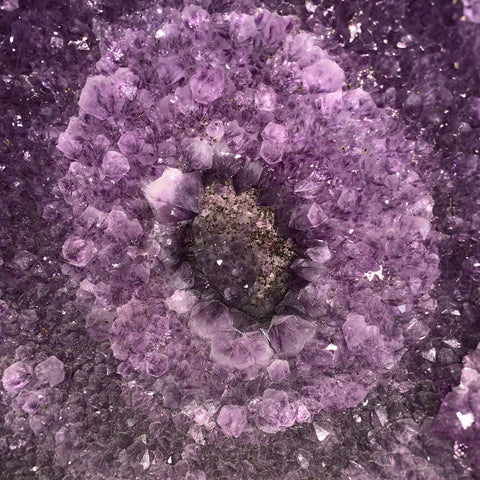
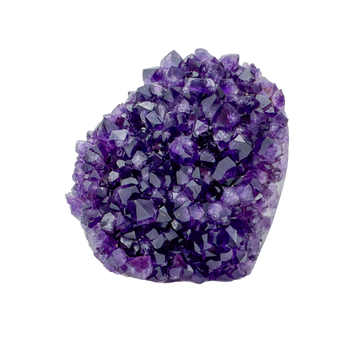
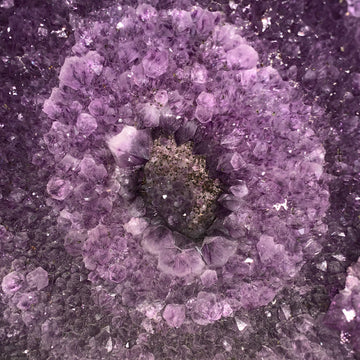
An amethyst geode from Artigas, Uruguay. It began as a gas bubble in basalt, sealed first by the gray chalcedony rind at its base.
Volcanic geodes
Born in cooled lava
Sedimentary geodes
Born in layered rock
The Slow Fill, From Rind to Crystal
Once a cavity exists, water rich in dissolved silica seeps through the surrounding rock and reaches the void. The first silica to settle forms chalcedony, an ultra-fine quartz that coats the walls and effectively waterproofs the pocket. As temperature and chemistry shift over time, that chalcedony can lay down in bands, which is the agate rind you often see at a geode's edge.
After the rind is in place, larger and better formed crystals grow toward the open middle, leaving the hollow lined with sparkling points known as druzy. Where the growing quartz holds traces of iron and sits near natural radiation in the host rock, the crystals can take on the violet of amethyst. Strong heat can shift that purple toward the golden tones of citrine, which is why a good deal of inexpensive citrine is simply heated amethyst.

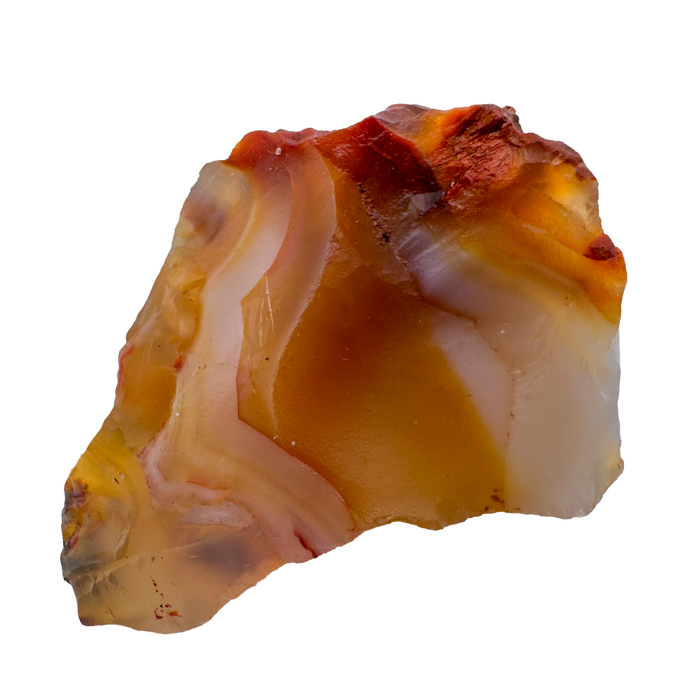
Banded chalcedony, the same microcrystalline quartz that lines a cavity before larger crystals appear.

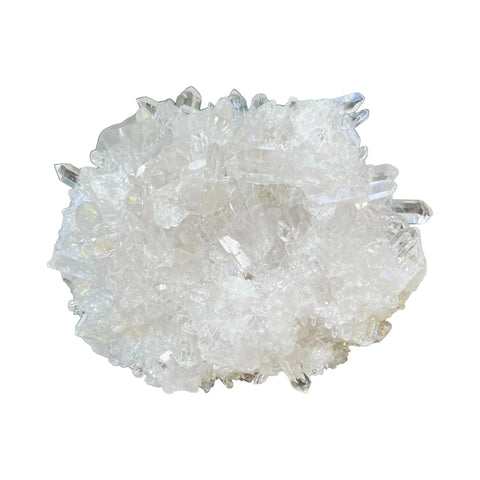
Once the rind is laid down, well formed quartz crystals grow inward toward the open center.
"A geode grows from the outside in, which is why the crystals always point toward the empty middle."
A geode is defined by its hollow. A rock of the same kind that filled in completely, with no open center, is a nodule. A thunder egg is a related structure that forms in rhyolite, usually with a solid agate core, and it gets called a geode only when it happens to be hollow. Geologists do not all draw these lines the same way.
Why Brazil and Uruguay Hold the Giants
The world's great amethyst and agate geodes come mostly from southern Brazil and northern Uruguay. Both sit on the Parana basalt, one of the largest volcanic rock formations on Earth, laid down by enormous eruptions as the supercontinent Gondwana pulled apart roughly 134 million years ago. That sea of basalt gave the region countless gas-bubble cavities to fill.
For a long time how those cavities filled was debated. Research published in 2024 by the University of Gottingen found that the Uruguayan amethyst crystallized at surprisingly low temperatures from groundwater-like fluids, water from the ordinary weather cycle rather than scorching hydrothermal brines. The sedimentary geodes of the US Midwest tell a slower, cooler story too, forming in much older sea-floor limestone and shale.
Age of the Parana basalt eruptions that host Brazil and Uruguay's amethyst geodes
Age of the Warsaw Formation that holds the Keokuk geodes of the US Midwest
Height of the Empress of Uruguay, the largest known amethyst geode, at about 2.5 tons
Sources: University of Gottingen research on the Parana Magmatic Province; geological surveys of the Warsaw Formation; the Empress of Uruguay, Crystal Caves.
Geodes range from thumb-sized stones to hollow chambers a person can stand inside. The Empress of Uruguay, found near Artigas in 2007, stands about eleven feet tall and weighs roughly two and a half tons. Most of what we sell sits comfortably between those extremes, but every piece, large or small, formed by the same patient process.
Go Deeper
The amethyst-specific deep dive, including why Brazil produces so many.
Read the guideProperties, meaning, and how we source amethyst at Beyond Bohemian.
Explore amethystThe banded chalcedony that lines the rim of so many geodes.
Explore agateShop hand-selected clusters and geodes, inspected and graded.
Shop the collectionHow quartz hardness shapes the way you clean and display a geode.
Check durabilityBrowse every Beyond Bohemian guide to sourcing, geology, and care.
Back to the LibraryGeode Formation FAQ
How long does it take for a geode to form?
There is no single answer. Estimates range from thousands to millions of years, because the rate depends on how long the cavity stays stable and how steadily mineral-rich water moves through it. The exact pace is very hard to measure, so most figures are broad approximations.
What is the difference between a geode and a nodule?
A geode has a hollow center, usually lined with crystals. A nodule is the same kind of rock filled in completely, with no open space inside. The only sure way to know which one you have is to open it or scan it.
Are geodes volcanic or sedimentary?
Both. Many famous geodes, including the amethyst geodes of Brazil and Uruguay, form in volcanic basalt. Others, such as the Keokuk quartz geodes of the US Midwest, form in sedimentary limestone and shale.
Why are amethyst geodes purple?
Amethyst owes its color to trace iron held inside the quartz combined with natural radiation from the surrounding rock. Together, over long spans, they create color centers that absorb light and produce the violet hue. Both the iron and the radiation are needed.
Where do most amethyst geodes come from?
The leading sources are Ametista do Sul in Rio Grande do Sul, Brazil, and the Artigas region of northern Uruguay. Both sit on the Parana basalt, a vast volcanic formation that gave the area abundant gas-bubble cavities to fill.
What is the largest amethyst geode ever found?
The Empress of Uruguay is widely cited as the largest. Found near Artigas in 2007, it stands about eleven feet tall and weighs roughly two and a half tons. It is now displayed at the Crystal Caves museum in Australia.
Is a thunder egg the same as a geode?
Not quite. A thunder egg is a nodule-like structure that forms in rhyolite, usually with a solid agate core. It is only called a geode when it happens to be hollow inside, and geologists do not all classify the two the same way.
What is the white or gray band around a geode's crystals?
That outer layer is chalcedony, a microcrystalline form of quartz that lines the cavity first. When it builds up in fine bands it is called agate, and it forms the rind that frames the crystals at the center.