























































Real clear quartz or molded glass? The simple, non-destructive signs to check, and why a transparent seller matters most.
Is Your Clear Quartz Real or Glass? How to Tell the Difference

Clear quartz is the crystal most people start with. It's clear, it's affordable, and it's everywhere. That last part is exactly why it's also the stone most often imitated with ordinary molded glass.
The good news: you don't need a lab to tell the two apart. A few minutes and your own senses will get you most of the way there. Here's what to look for, which tests to skip, and the one check that beats all the others.
Why glass ends up labeled as clear quartz
Glass is cheap to mold, perfectly clear, and easy to shape into points and spheres. Natural quartz has to be mined, sorted, and cut. When a price looks too good for a flawless, water-clear point, glass is often the reason. Sometimes it's labeled honestly as “quartz glass” or “glass crystal.” Other times it isn't labeled at all, and that's the part we think buyers deserve better than.
It helps to know that real clear quartz is genuinely common and affordable. It's one of the most abundant minerals on earth, so an honest piece doesn't have to be expensive. That's worth remembering, because the goal here isn't to make you suspicious of every clear stone. It's to help you recognize the handful of signs that separate the real thing from a look-alike.
None of this means clear quartz is hard to buy well. It just means a little knowledge protects you, and it makes you a sharper shopper everywhere you look.
Four signs you can check at home
1. Bubbles
This is the giveaway. Molded glass traps tiny round air bubbles as it cools. Hold the piece up to a bright light and look inside. Perfectly round bubbles, especially several of them in a line or cluster, point to glass. Natural quartz can have veils, fractures, or wispy internal lines, but it doesn't form neat spherical bubbles.
2. Inclusions and natural flaws
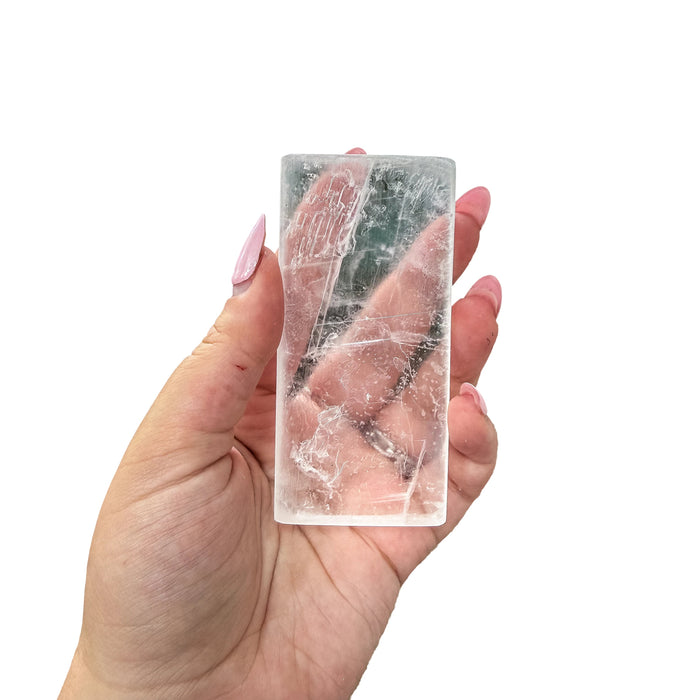
Real quartz grows over thousands of years inside rock, so it usually carries small reminders of that history: faint internal veils, tiny fractures, a cloudy phantom, or a faint trace of trapped minerals. Glass tends to be flawless and uniform throughout. If a clear point looks absolutely perfect, with no character at all, treat that as a reason to ask more questions, not fewer.
3. Temperature
Quartz conducts heat better than glass, so it feels cooler when you first pick it up and it warms more slowly in your hand. Glass warms quickly to your body temperature. It's a subtle test on its own, but combined with the others it adds confidence.
4. Hardness
Quartz sits at 7 on the Mohs hardness scale. Ordinary glass is softer, usually around 5.5. That means real quartz will lightly scratch a piece of glass, while glass won't scratch quartz. If you try this, use a spare piece of scrap glass and a hidden spot, never a finished piece you care about.
| What you're checking | Real clear quartz | Molded glass |
|---|---|---|
| Bubbles | None; may show veils or fractures | Round trapped air bubbles |
| Clarity | Often has inclusions or phantoms | Usually flawless and uniform |
| Temperature | Cool, slow to warm | Warms quickly in hand |
| Hardness (Mohs) | 7; scratches glass | ~5.5; scratched by quartz |
The tests worth skipping
You'll see two more tests floating around online. The first is the hot-point test, holding a heated needle to the stone to see if it melts. The second is dropping or striking the piece to see if it shatters. Both can damage or destroy your crystal, and neither tells you anything the gentler checks above won't. Please skip them. A crystal you had to break to identify isn't much of a win.
Where real clear quartz actually comes from
Clear quartz is silicon dioxide, the same mineral family as amethyst and citrine, grown in hydrothermal veins and pockets deep in the earth. Brazil is the best-known source, especially the state of Rio Grande do Sul, along with Madagascar and Arkansas in the United States. Knowing a stone's origin is part of buying it well, and it's something an honest seller should be able to tell you. You can see where ours comes from on each listing in our clear quartz collection, and read more about how stones form in our crystal guide.
The simplest check of all
Here's the test that beats bubbles, temperature, and hardness combined: buy from someone who tells you exactly what you're getting. Origin, grade, whether a stone was treated, and what it's actually made of. When a seller is specific and open about all of it, you rarely have to play detective at all. When they're vague, that vagueness is your answer.
Clusters raise the same question in a different shape. How to spot a fake crystal cluster covers what to look at on a cluster before you buy.
That's the standard we hold ourselves to. Every piece we carry comes with its origin and its story, because we'd rather you trust the label than have to test it. You can read how we choose what we sell on our Beyond Ethical sourcing page.
Coated quartz is its own category. Is aura quartz natural explains what that metallic finish actually is and how it is made.
Next time a clear point catches your eye, hold it up to the light and take a closer look. Whether it's ours or someone else's, you'll know what you're holding. And that's a good place to start with any crystal.