













How to Spot a Fake Crystal Cluster: 5 Tells to Check

A cluster is the piece people fall for first. All those points catching light at once, a whole miniature landscape sitting in your palm. It is also the shape that gets faked more often than almost anything else in the crystal market, because a cluster is easy to mold and hard for a beginner to read.
The good news is that clusters give themselves away faster than tumbled stones do. A tumble hides everything under a polish. A cluster has to show you its geometry, and geometry is very hard to fake convincingly.
Most fake crystal clusters are one of three things: molded glass or resin, lab-grown quartz sold as natural, or a real cluster that was heated, dyed, or coated without disclosure. The tell is uniformity. Natural points vary in size, angle, and clarity. Manufactured ones repeat, and the price is usually too low for the size.
"Fake" is really three different problems
Before you can spot a fake, it helps to know what you are actually looking for. The word gets used for three very different situations, and only one of them is truly a counterfeit.
Man-made material
- What it is
- Molded glass, resin, or plastic shaped to look like a cluster.
- The tell
- Round air bubbles, swirl marks, a warm feel in the hand, scratches with a steel blade.
- Fair to sell?
- Only as a decorative object, never as a mineral specimen.
Lab-grown quartz
- What it is
- Chemically real quartz grown in a factory rather than in the ground.
- The tell
- Flawless clarity, identical points, no matrix, no contact marks, no damage anywhere.
- Fair to sell?
- Yes, if it is labeled as lab-grown. The problem is silence, not the stone.
Treated or coated
- What it is
- A natural cluster that was heated, dyed, or given a metallic aura coating.
- The tell
- Colors nature does not make. Burnt orange tips on a white base. Iridescent rainbow sheen.
- Fair to sell?
- Yes, with disclosure. The treatment is not the issue. Hiding it is.
The five tells on a cluster
Work through these in order. You can do all five in about thirty seconds with your eyes and one hand.
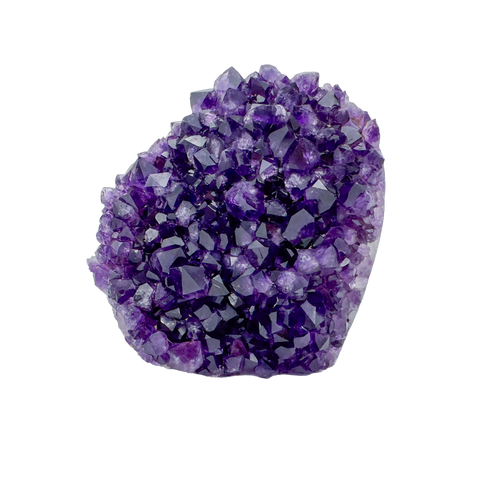
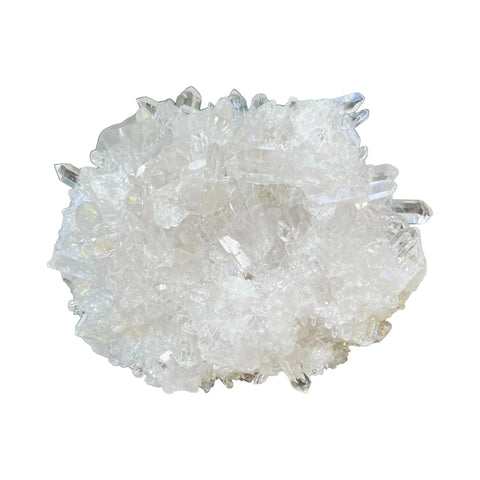
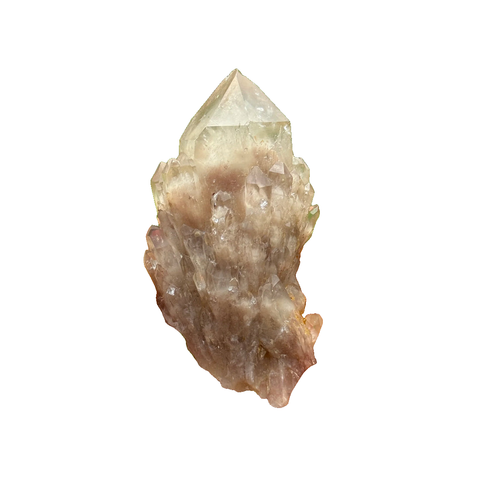
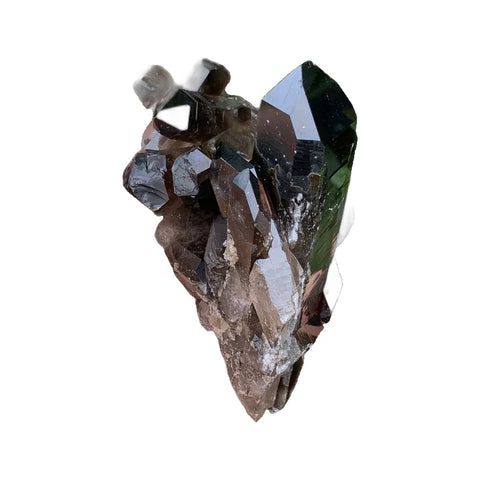
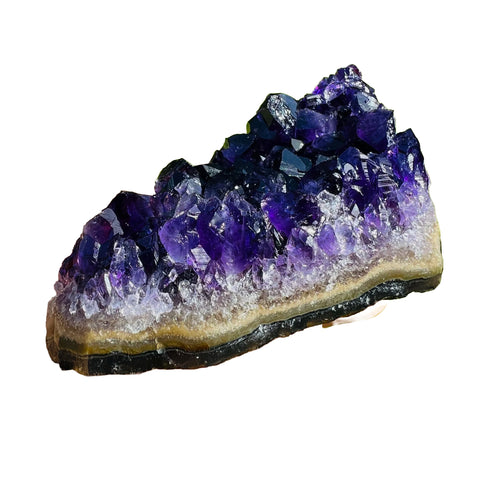
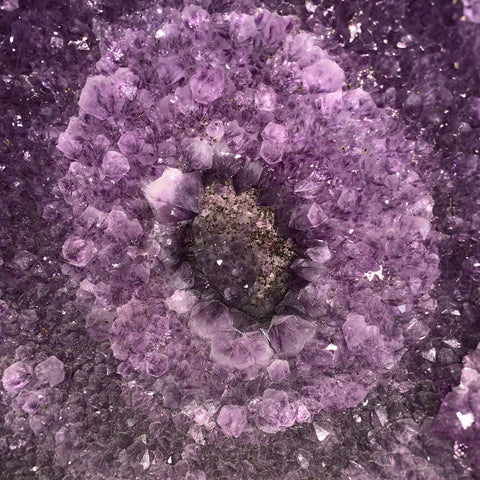
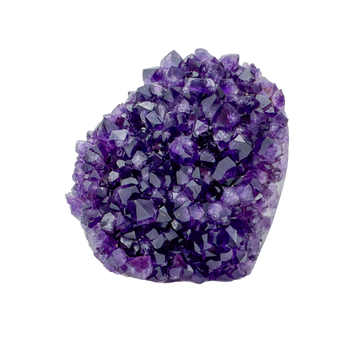
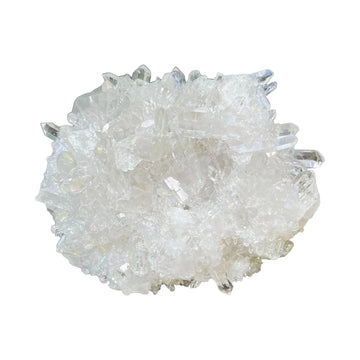
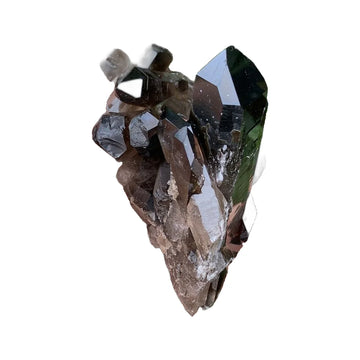
- Look for variation, not perfection. This is the single most useful tell. On a natural cluster the points differ. Some are tall, some are stubby, some lean, some are cloudy at the base and clear at the tip. A few will have chips or contact marks where a neighboring crystal was growing against them. Manufactured clusters repeat: every point the same height, the same angle, the same clarity, all leaning the same direction.
- Read the point faces. A real quartz termination has flat, glassy faces that meet at sharp edges and catch light in distinct planes. Molded and grown imitations often have faces that look soft, uneven, grainy, or slightly fuzzy at the surface, because they were never built by actual crystal growth.
- Turn it over and look at the base. Natural clusters grew attached to something. You should see matrix, a broken contact surface, or at minimum an irregular underside. A base that is perfectly flat, perfectly round, or smoothly finished all the way around is a strong sign the piece was cast or cut to sit prettily on a shelf.
- Hunt for bubbles. Hold the piece up to a bright light and look inside. Perfectly round air bubbles mean glass. Nature does not make them. Swirls, like the inside of a marble, mean the same thing. Natural inclusions are angular, cloudy, or wispy, never neat little spheres.
- Check the price against the size. A large, symmetrical, flawless cluster for twenty dollars is answering your question before you ask it. Real material of that quality is scarce and the shipping weight alone is expensive.

Natural versus manufactured, side by side
| What you check | Natural cluster | Manufactured or cast |
|---|---|---|
| Point size and angle | Varies across the piece. Some tall, some short, some leaning. | Repeats. Uniform height, uniform angle. |
| Termination faces | Flat, glassy, sharp edges, distinct planes. | Soft, grainy, uneven, or slightly fuzzy. |
| Base | Matrix, broken contact, irregular underside. | Flat, round, or smoothly finished all around. |
| Inclusions | Angular, cloudy, wispy, uneven. | Round bubbles or glassy swirls, or nothing at all. |
| Damage | Usually some. Chips and contact marks are normal. | Often pristine, which is the giveaway. |
| Hardness | Quartz is 7 on the Mohs scale. It scratches glass. | Glass is around 5.5 and resin is far softer. Both scratch easily. |
Two tests you can actually do at home
You do not need a lab. You need a window and a discreet corner of the specimen.
The light test. Take the cluster to a bright window and look through the thickest point. Round bubbles or ribbon-like swirls mean you are holding glass. Quartz will show you veils, fractures, and cloudy zones instead, and none of them will look tidy.
The scratch test, done responsibly. Quartz sits at 7 on the Mohs scale, so it will scratch glass, and glass will not scratch it. If you own a scrap piece of glass, drag an unimportant point of the cluster across it. Real quartz leaves a line. Glass and resin will not. Test on the least visible edge, and skip this entirely on softer minerals like calcite, fluorite, or selenite, which are soft enough to damage themselves.
The clusters that get mislabeled most
Not every problem is a counterfeit. Some of the most common ones are real stones wearing the wrong name.
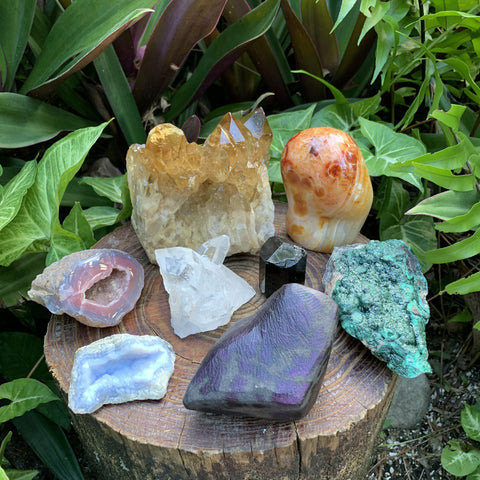
Bright orange "citrine" clusters. Most are heat-treated amethyst. Look for a burnt orange concentrated at the tips fading abruptly into a stark white base. Natural citrine is usually a softer, more even yellow. The treatment is stable and legitimate. Selling it as natural citrine at natural citrine prices is not. We wrote the full comparison in real versus fake citrine.
Rainbow-sheen clusters. That metallic iridescence is a coating, applied by bonding vaporized metal to the surface of a natural cluster. It is a real stone underneath. It should be sold as aura-coated, and the word "aura" in a name is usually your cue.
Impossibly saturated colors. Neon blue, hot pink, and vivid green clusters are typically dyed. Look into the fractures. Dye pools and darkens there, leaving veins of concentrated color that natural banding does not produce.
Three questions that settle it
If a listing has you unsure, you do not have to become a gemologist. You just have to ask, and then listen to how the answer arrives.
- Is this cluster natural, lab-grown, or man-made material?
- Has it been heated, dyed, or coated in any way?
- Where did the material come from?
A seller who knows their supply chain answers all three in a sentence, without hedging. A seller who goes quiet, or who answers only with the word "authentic," has told you something too.
Where we land on it
The reason fakes work is not that buyers are careless. It is that the market rewards silence. A shop can say nothing about treatment, nothing about origin, and nothing about whether a stone was grown in the ground or in a vessel, and still sell the piece. That gap is the whole problem, and it is why we say the treatment is rarely the issue. The label is.
Every cluster we list says what it is, where it came from, and whether anything was done to it. If a piece is treated we say so in the description, not in fine print. You can read the standard we hold ourselves to on our sourcing standards page, see how the same question plays out with lab material in lab-grown versus natural crystals and with glass in is your clear quartz real or glass, or browse the real thing in our amethyst collection.
A note on what clusters are for
Once the authenticity question is settled, a cluster is a lovely thing to live with. Clusters are traditionally associated with holding and steadying the energy of a room, which is why people set them in shared spaces rather than carrying them in a pocket. That association does not depend on whether the piece came from Brazil or a factory. But what you paid, and what you believe you are holding, very much does.
Natural clusters vary and manufactured ones repeat. Look for differing point heights, glassy flat faces, an irregular base, and no round bubbles. Then ask the seller three questions and listen for hedging.
Trust the geometry. It is much harder to fake than a photograph.