




















































 Raw Stones
179 pieces
Raw Stones
179 pieces
 Tumbled Stones
162 pieces
Tumbled Stones
162 pieces
 Palm Stones
25 pieces
Palm Stones
25 pieces
 Crystal Points
23 pieces
Crystal Points
23 pieces
 Clusters & Geodes
105 pieces
Clusters & Geodes
105 pieces
 Polished & Decor
151 pieces
Polished & Decor
151 pieces
 Mineral Specimens
262 collector pieces
Mineral Specimens
262 collector pieces
 Crystal Chips
21 pieces
Browse everything
Every collection, one page.
View All Collections →
Crystal Chips
21 pieces
Browse everything
Every collection, one page.
View All Collections →


 Aries
Mar 21 – Apr 19
Carnelian
›
Aries
Mar 21 – Apr 19
Carnelian
›
 Taurus
Apr 20 – May 20
Rose Quartz
›
Taurus
Apr 20 – May 20
Rose Quartz
›
 Gemini
May 21 – Jun 20
Agate
›
Gemini
May 21 – Jun 20
Agate
›
 Cancer
Jun 21 – Jul 22
Moonstone
›
Cancer
Jun 21 – Jul 22
Moonstone
›
 Leo
Jul 23 – Aug 22
Citrine
›
Leo
Jul 23 – Aug 22
Citrine
›
 Virgo
Aug 23 – Sep 22
Amazonite
›
Virgo
Aug 23 – Sep 22
Amazonite
›
 Libra
Sep 23 – Oct 22
Blue Lace Agate
›
Libra
Sep 23 – Oct 22
Blue Lace Agate
›
 Scorpio
Oct 23 – Nov 21
Obsidian
›
Scorpio
Oct 23 – Nov 21
Obsidian
›
 Sagittarius
Nov 22 – Dec 21
Sodalite
›
Sagittarius
Nov 22 – Dec 21
Sodalite
›
 Capricorn
Dec 22 – Jan 19
Black Tourmaline
›
Capricorn
Dec 22 – Jan 19
Black Tourmaline
›
 Aquarius
Jan 20 – Feb 18
Amethyst
›
Aquarius
Jan 20 – Feb 18
Amethyst
›
 Pisces
Feb 19 – Mar 20
Aquamarine
›
Gifting?
A birthday stone is the safe bet.
Read the zodiac guide →
Pisces
Feb 19 – Mar 20
Aquamarine
›
Gifting?
A birthday stone is the safe bet.
Read the zodiac guide →











Shattuckite
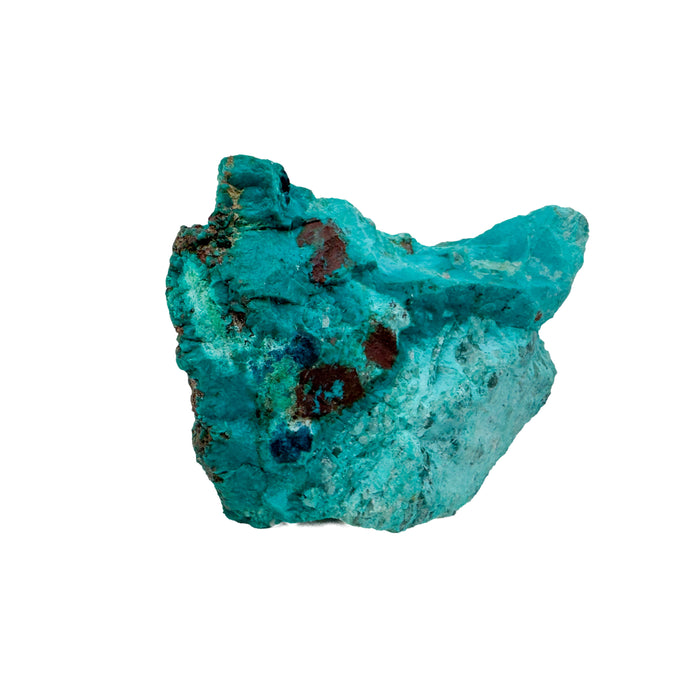
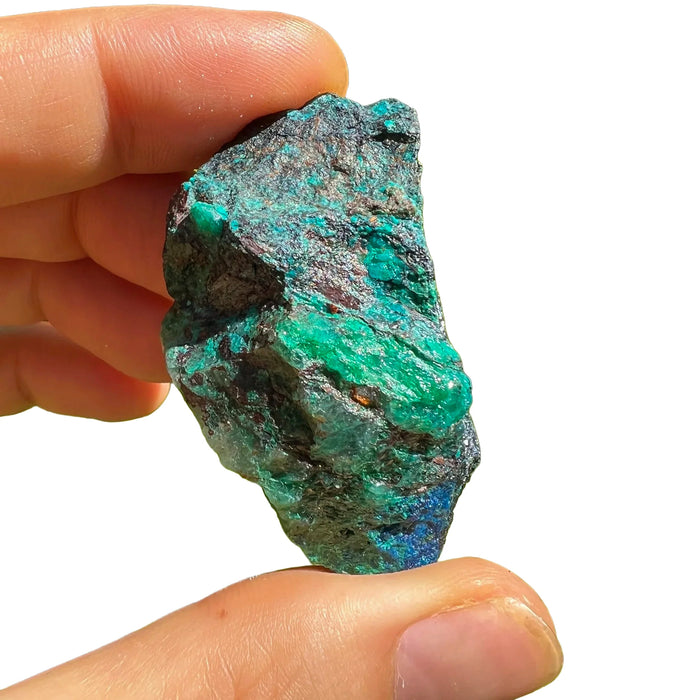
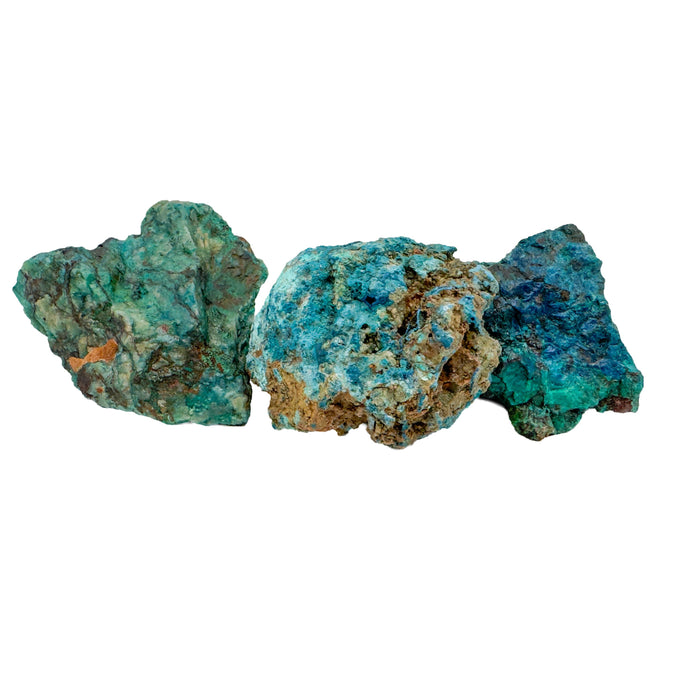
Shattuckite is a rare copper silicate with a saturated blue-to-blue-green color, almost always found intergrown with Chrysocolla and other copper minerals. Traditionally associated with honest speech, intuition, and the kind of communication that comes from genuine knowing rather than performance. A relatively modern stone with a short but rich working tradition.
Shop shattuckiteThe geology.
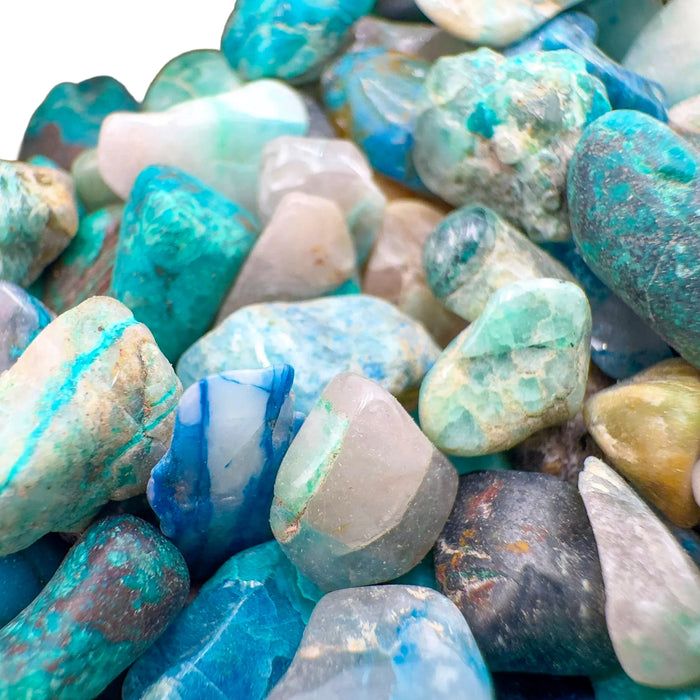
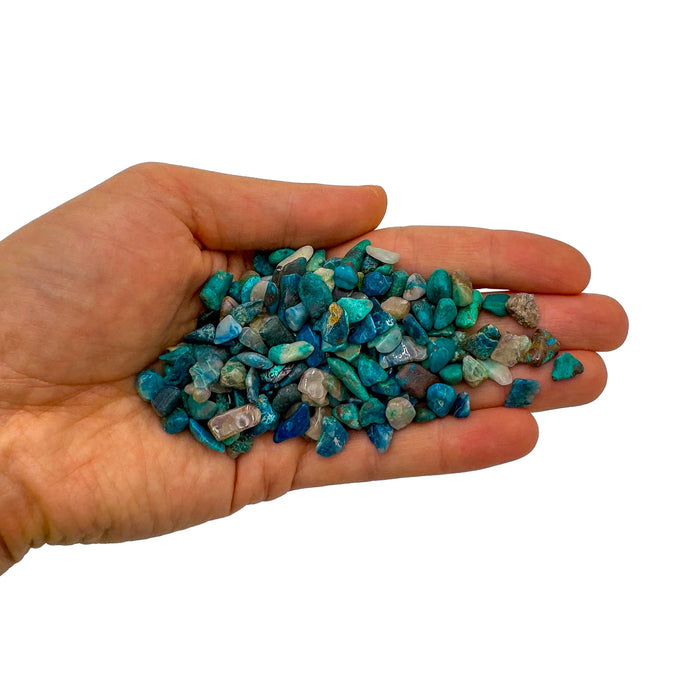
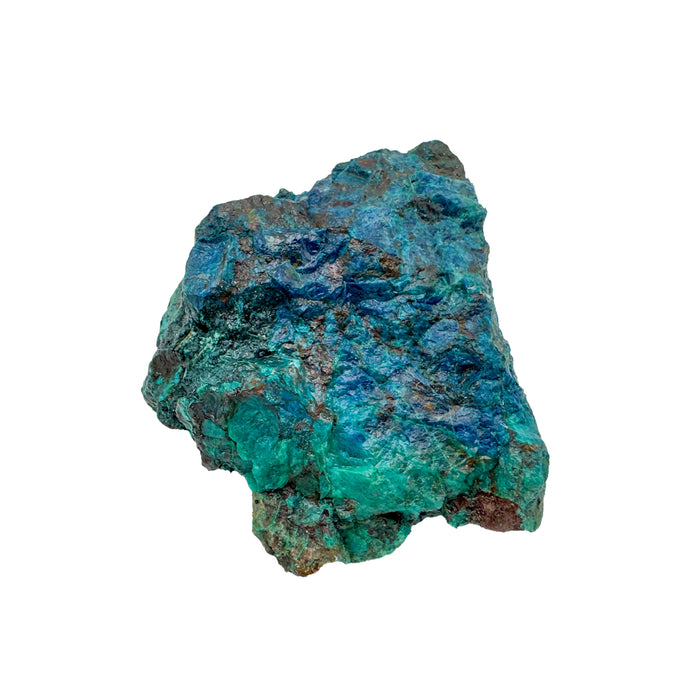
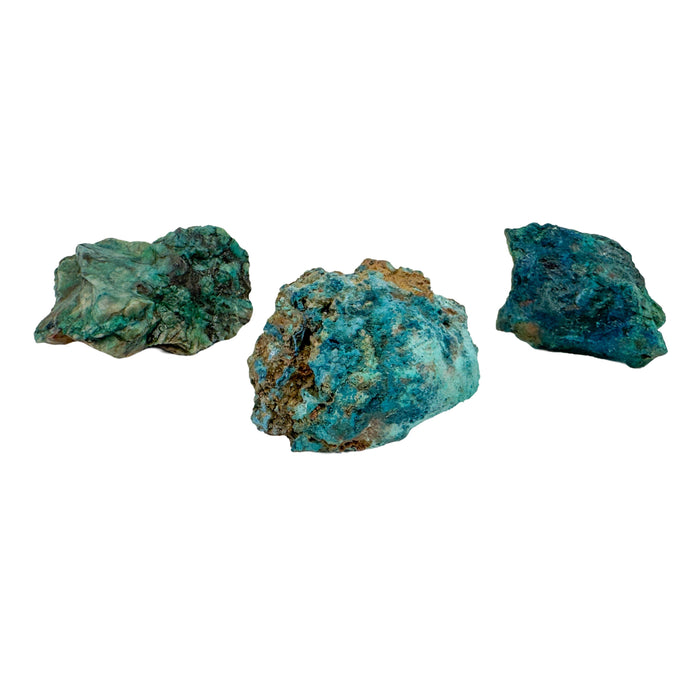
Shattuckite is a copper silicate mineral with the chemical formula Cu₅(SiO₃)₄(OH)₂. Its deep blue-to-blue-green color comes directly from the copper content. Most commercial Shattuckite is found intergrown with Chrysocolla (a related copper silicate), Malachite, Azurite, and Dioptase, which is why most polished pieces on the market show a mix of blue and green bands or patches rather than a uniform color.
Hardness sits at 3.5 on the Mohs scale, which puts it firmly in the soft category. It scratches easily and isn't suited for rings subjected to physical work. Cleavage is perfect in one direction, fracture is uneven to conchoidal, and the polished surface has a silky-to-vitreous luster. The name honors the Shattuck Mine in Bisbee, Arizona, where the material was first identified in 1915.
The origins.
Shattuckite is a rare mineral, found commercially in only a handful of localities worldwide. Namibia's Kaokoland and Erongo regions are the primary sources of specimen and tumbled material, often in intergrown matrix with Chrysocolla. The Democratic Republic of Congo (particularly the Katanga copper belt) yields collector-grade pieces. Arizona's Shattuck Mine in Bisbee is the type locality but produces very limited material today. Smaller occurrences exist in Australia and Greece.
Each source has a signature. Namibian material tends toward the cleanest, most saturated blue and is the most common commercial supply. Congolese Shattuckite often shows deeper coloration with more pronounced Chrysocolla mixing. Arizona specimens carry historical and collector pedigree. Pieces are typically sold as Shattuckite-Chrysocolla combos rather than pure Shattuckite, which is unusual in any quantity.
Traditional associations.
Shattuckite's formal tradition is short because it wasn't identified as a distinct mineral species until 1915. Use in the contemporary metaphysical market took off in the 1980s and 90s, as African sources from Namibia and the DRC opened to global trade. The working associations draw on both the blue color (traditionally linked to throat-chakra and communication work across many systems) and on its copper content (associated with flow and conduction in a range of older traditions).
Many people work with Shattuckite for honest speech, intuitive communication, and channeling information without distortion. It's most commonly associated with the Throat and Third Eye chakras, the elements of Water and Air, and the zodiac signs Sagittarius and Aquarius. The classic working is to hold a piece during meditation or carry one during a difficult conversation.
Spotting the real thing.
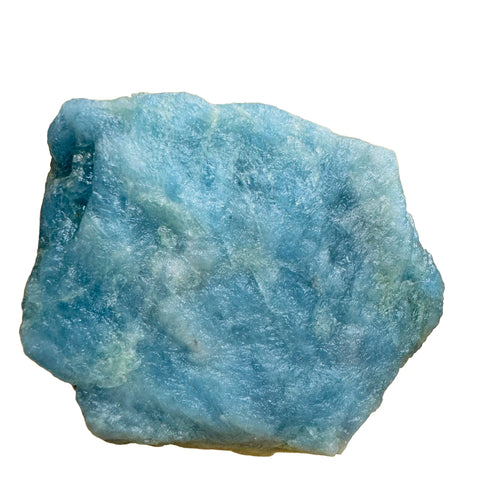
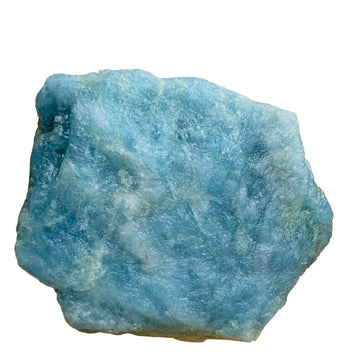
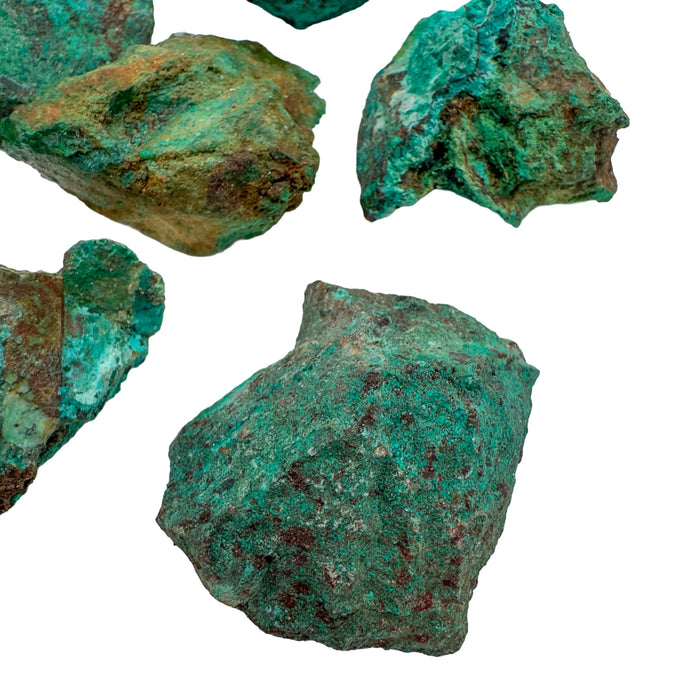
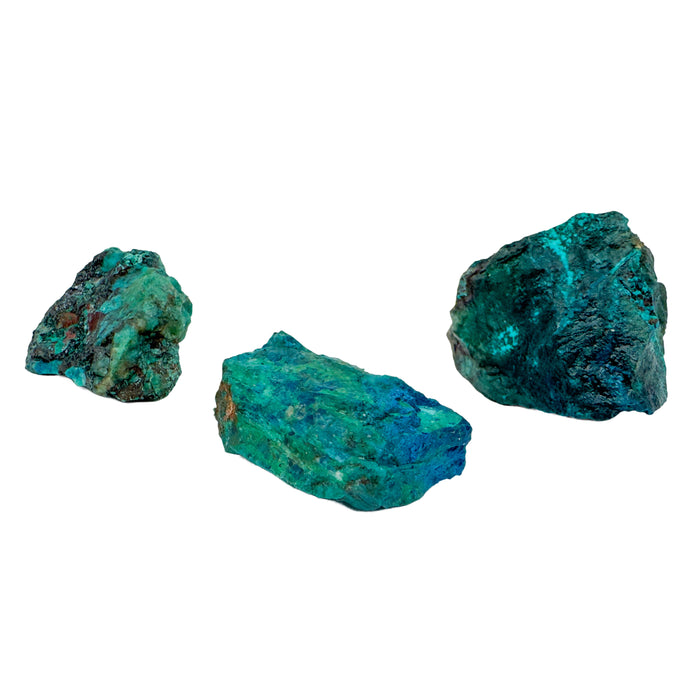
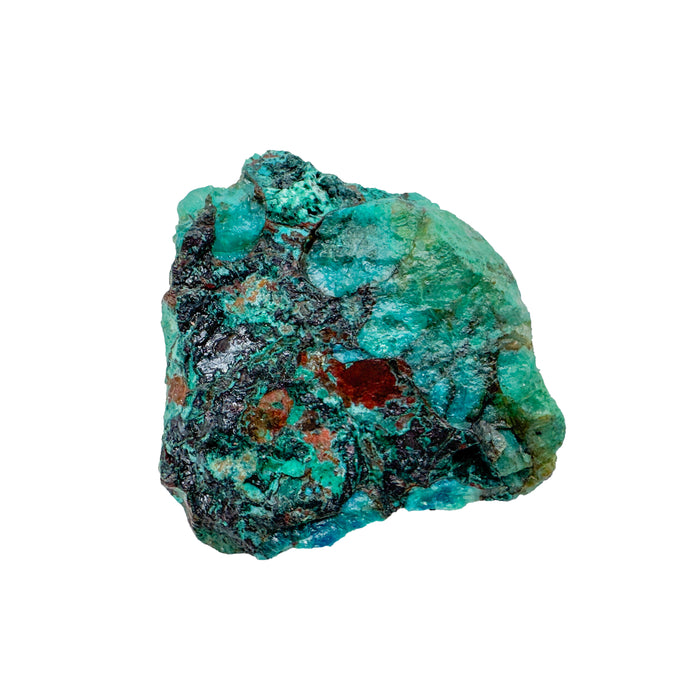
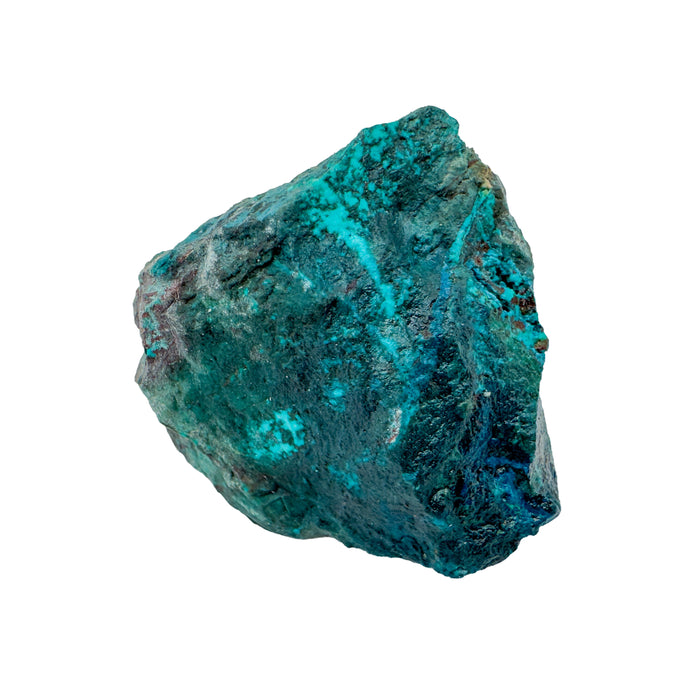
Real Shattuckite shows a deep blue to blue-green color with natural variation across a single piece, often with visible Chrysocolla (lighter blue-green) and Malachite (green) bands or patches mixed in. Under a loupe you can sometimes see fibrous or radial crystalline structure. The stone feels notably cool to the touch and has a slight heft from the copper content.
Dyed howlite and dyed magnesite are the most common imitations. Dyed pieces show uniform, flat color with no natural variation or mineral banding. Dye often pools in surface fractures. Real Shattuckite is softer than the steel point of a knife but harder than a fingernail, which is a rough hardness check that separates it from dyed chalky minerals. Reputable sellers name both the country of origin and any associated minerals in the piece.
Care & handling.
Water-safe for a brief rinse with lukewarm water and a soft cloth only. Skip ultrasonic cleaners, steam cleaners, and any acidic or abrasive cleaners, which can damage the softer copper minerals. Avoid prolonged water contact; the copper silicates can slowly break down with extended moisture exposure. Keep out of direct sun for long-term storage.
Cleanse energetically with moonlight, sound, smoke, or by placing on selenite overnight. Never use salt or saltwater on Shattuckite (the copper minerals react). At 3.5 on the Mohs scale it's soft, so store in a small pouch on its own, away from harder stones that will scratch the polish. Handle with care in jewelry settings; protected pendants work better than rings.
Pairs well with.
Proof, not promises.
We measure our own sourcing across five dimensions. Supply chain, environmental footprint, artisan support, market integrity, and pricing. The number is honest, not perfect. Where we can do better, we say so.
A deeper look.
Extended geology, sourcing, authentication, history, varieties, and pricing, for when the quick guide isn't quite enough.
Extended geology
Shattuckite is a copper silicate with chemical formula Cu₅(SiO₃)₄(OH)₂, crystallizing in the orthorhombic system. It forms as a secondary mineral in the oxidation zones of copper ore deposits, typically as fibrous or massive aggregates rather than distinct crystals. The intense blue color derives from Cu²⁺ ions in the silicate structure.
Specific gravity runs 3.8 to 4.1 (notably heavy for the hardness). Mohs hardness 3.5. Perfect cleavage in one direction. Fracture uneven to conchoidal. Luster vitreous to silky. Nearly always found intergrown with Chrysocolla, Malachite, Azurite, or Dioptase in the same matrix.
Extended sourcing
Namibia is the dominant commercial producer. The Kaokoland region in northwestern Namibia yields most of the small-shop Shattuckite-Chrysocolla matrix material. The Erongo region produces higher-grade specimens. Congolese material from the Katanga copper belt is prized for depth of color and mineral association.
The Shattuck Mine in Bisbee, Arizona, is the historical type locality where the mineral was first identified and named in 1915. It has produced very limited Shattuckite in modern times and what exists is mostly in museum and collector circulation. Australia (Queensland) and Greece (Laurion) have small occurrences.
Authentication and warning signs
Real Shattuckite shows a deep natural blue with subtle variation across the piece, often with visible Chrysocolla (paler blue-green) and sometimes Malachite (green) bands or patches. Under magnification, the fibrous crystal structure is sometimes visible. The stone feels heavy for its size due to the copper content.
Dyed howlite and dyed magnesite are the main imitations at the bottom of the market. They show uniform saturated blue without natural variation, and dye pools in surface fractures. A hardness test separates them: real Shattuckite won't scratch glass, but neither will dyed howlite. Weight is more diagnostic: real Shattuckite is noticeably denser than dyed white minerals.
Historical and cultural context
Shattuckite was first described and named in 1915 by mineralogist Waldemar Schaller, based on specimens from the Shattuck Mine in Bisbee, Arizona. The mine was one of the significant copper operations of the American Southwest, and the secondary minerals in its oxidation zone produced several unusual species.
Because the stone's scientific identification is so recent, there is no documented pre-modern tradition attached specifically to Shattuckite; earlier blue copper-silicate stones (Chrysocolla, Azurite) carry their own ancient associations that Shattuckite now inherits by visual similarity. Contemporary working practice treats it as a communication and channeling stone, often paired with Chrysocolla in the same piece as a natural blended working.
Varieties and trade names
Shattuckite proper: the pure copper silicate, rare in isolation.
Shattuckite-Chrysocolla: the most common commercial form, with the two minerals intergrown in the same piece.
Kaokoland Shattuckite: trade name for Namibian material from the Kaokoland region.
Bisbee Shattuckite: collector designation for type-locality Arizona material.
Pricing reality
Tumbled Shattuckite-Chrysocolla: 5 to 20 dollars per piece. Small polished cabochons and palm stones: 20 to 80 dollars. Larger specimen-grade pieces with strong Shattuckite content: 80 to 400 dollars. Fine pure Shattuckite specimens from Namibia or the DRC: 200 to 1,500 dollars. Museum-grade pieces: collector pricing.
Value drivers: depth and saturation of the blue, ratio of pure Shattuckite to associated copper minerals, size, clean polish, and documented origin. Warning signs: uniform saturated color without the natural banding typical of copper mineral matrix, no origin offered, or Shattuckite at prices that are too low even for dyed substitutes.
Good sourcing is a practice, not a claim.
Nothing we sell is dyed howlite, dyed magnesite, or Chrysocolla-only material sold as Shattuckite. We name our origins where we can. We say so when we cannot. We walk away from material that doesn't meet our standard, even when it costs us sales.
Bring shattuckite home.
Every piece we carry is photographed individually and listed with its own origin, mineral associations, and treatment notes. What you see is what ships.
Shop the shattuckite collectionShattuckite, in stock now.
Our most-loved Shattuckite pieces, ready to ship.

- from 1,000+ reviews
- Ships within 72 hoursMonday to Friday, tracked
- 90 days to return itif you do not love it
- Free US shipping over $99$8.99 flat rate under
The Slow Note
New stones go to the list first.
No forwarding, no selling. Unsubscribe in one click. Privacy