









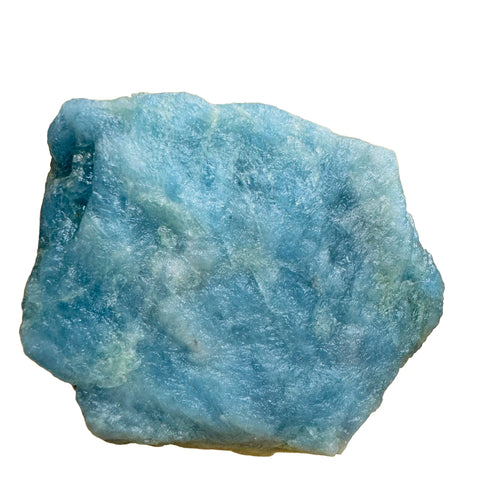











































 Raw Stones
179 pieces
Raw Stones
179 pieces
 Tumbled Stones
162 pieces
Tumbled Stones
162 pieces
 Palm Stones
25 pieces
Palm Stones
25 pieces
 Crystal Points
23 pieces
Crystal Points
23 pieces
 Clusters & Geodes
104 pieces
Clusters & Geodes
104 pieces
 Polished & Decor
148 pieces
Polished & Decor
148 pieces
 Mineral Specimens
259 collector pieces
Mineral Specimens
259 collector pieces
 Crystal Chips
21 pieces
Browse everything
Every collection, one page.
View All Collections →
Crystal Chips
21 pieces
Browse everything
Every collection, one page.
View All Collections →


 Aries
Mar 21 – Apr 19
Carnelian
›
Aries
Mar 21 – Apr 19
Carnelian
›
 Taurus
Apr 20 – May 20
Rose Quartz
›
Taurus
Apr 20 – May 20
Rose Quartz
›
 Gemini
May 21 – Jun 20
Agate
›
Gemini
May 21 – Jun 20
Agate
›
 Cancer
Jun 21 – Jul 22
Moonstone
›
Cancer
Jun 21 – Jul 22
Moonstone
›
 Leo
Jul 23 – Aug 22
Citrine
›
Leo
Jul 23 – Aug 22
Citrine
›
 Virgo
Aug 23 – Sep 22
Amazonite
›
Virgo
Aug 23 – Sep 22
Amazonite
›
 Libra
Sep 23 – Oct 22
Blue Lace Agate
›
Libra
Sep 23 – Oct 22
Blue Lace Agate
›
 Scorpio
Oct 23 – Nov 21
Obsidian
›
Scorpio
Oct 23 – Nov 21
Obsidian
›
 Sagittarius
Nov 22 – Dec 21
Sodalite
›
Sagittarius
Nov 22 – Dec 21
Sodalite
›
 Capricorn
Dec 22 – Jan 19
Black Tourmaline
›
Capricorn
Dec 22 – Jan 19
Black Tourmaline
›
 Aquarius
Jan 20 – Feb 18
Amethyst
›
Aquarius
Jan 20 – Feb 18
Amethyst
›
 Pisces
Feb 19 – Mar 20
Aquamarine
›
Gifting?
A birthday stone is the safe bet.
Read the zodiac guide →
Pisces
Feb 19 – Mar 20
Aquamarine
›
Gifting?
A birthday stone is the safe bet.
Read the zodiac guide →

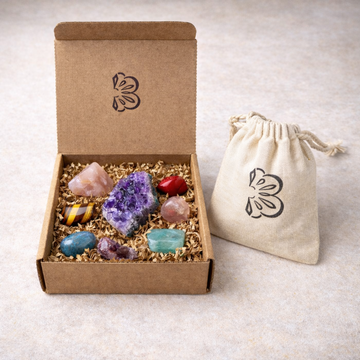
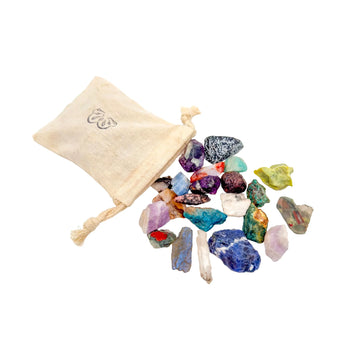










Pink Opal
Pink Opal is a variety of common opal from Peru's Andes, with a soft pink to salmon color that comes from trace palygorskite clay and organic matter embedded in the hydrated silica structure. Unlike precious opal, Pink Opal shows no color play or fire, just a gentle uniform pink. Traditionally associated with the quiet heart, emotional soothing, and the patient work of showing up for yourself.
Shop pink-opalThe geology.
Pink Opal is a variety of common opal, hydrated amorphous silica (SiO₂·nH₂O) containing 3 to 21 percent water by weight. Its distinctive soft pink-to-salmon color comes from trace palygorskite, a clay mineral, along with small amounts of organic matter embedded in the silica during formation. Unlike precious opal varieties (such as White Opal or Fire Opal), Pink Opal is classified as 'common opal' or 'potch' and shows no play-of-color or spectral fire, just a uniform pink body.
Hardness runs 5.5 to 6.5 on the Mohs scale, softer than most stones commonly set in jewelry. Amorphous structure (no crystal system) because silica spheres in opal are arranged without a repeating lattice. Vitreous to waxy luster, conchoidal fracture, no cleavage. Pink Opal is slightly porous and can absorb water and oils over time, which affects both care and color stability.
The origins.
Pink Opal is essentially a Peruvian stone in the commercial market. The primary source is the Andes of central Peru, particularly deposits in the Lima, Ica, and San Patricio regions. The Peruvian Andes produce almost all of the world's Pink Opal in commercial quantities. Australia is a secondary source, with some pink common opal from Queensland and New South Wales, though Australian production of precious opal dwarfs its pink common opal output. Smaller deposits exist in Mexico and Indonesia but are not commercially significant.
Within Peru, different mining areas produce slightly different color tones. Central Peru tends toward softer pastel pinks; some Peruvian deposits produce saltwater-and-sky pink salmon. Andean Pink Opal almost always shows some natural banding or variation in color across a piece, because the palygorskite clay distribution during formation wasn't perfectly uniform.
Traditional associations.
Pink Opal has a documented tradition in Andean indigenous culture, where it has been worked for centuries as a heart-centered ceremonial and ornamental stone. Pre-Incan and Incan tradition associated Pink Opal with Pachamama (the Earth Mother) and used it in offerings and ceremonial objects. Because Andean deposits were outside major global trade networks until the twentieth century, Pink Opal has a shorter international tradition than White or Fire Opal.
Many people work with Pink Opal for quiet heart work, emotional soothing, and the patient showing-up-for-yourself that doesn't need dramatic shifts. It's most commonly associated with the Heart chakra, the element of Water, and the zodiac signs Cancer and Libra. The classic working is as a companion stone for long emotional healing rather than quick-shift work; often paired with Rose Quartz or Rhodochrosite for layered heart practice.
Spotting the real thing.
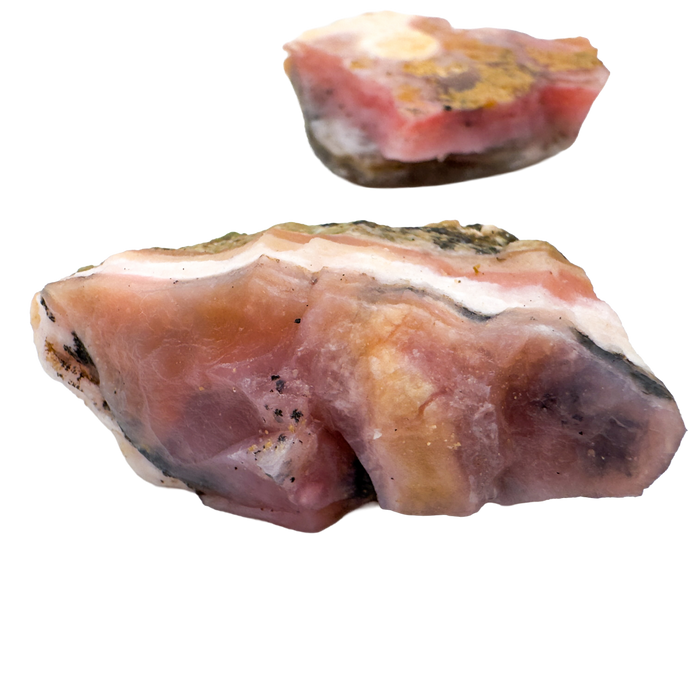
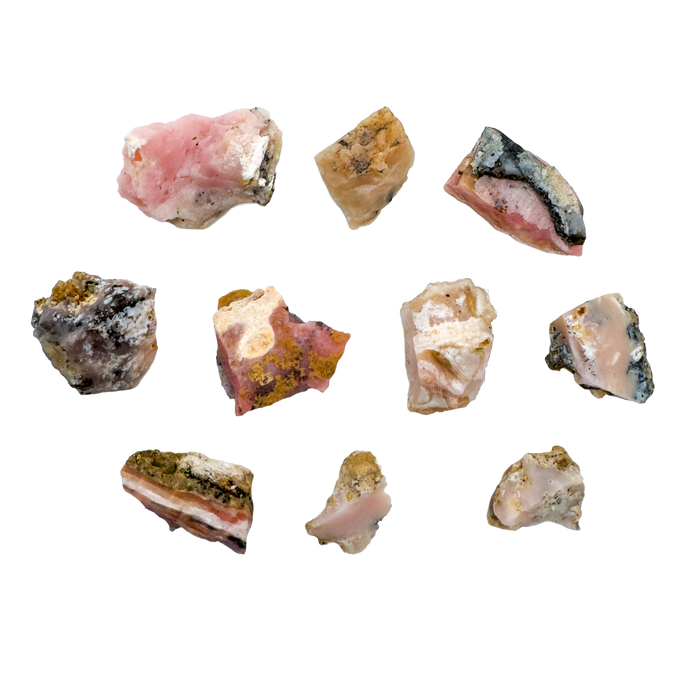
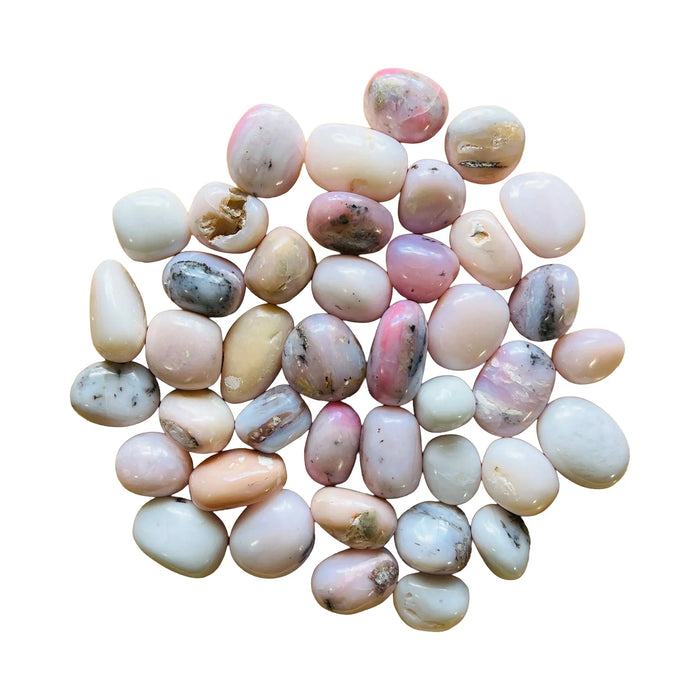
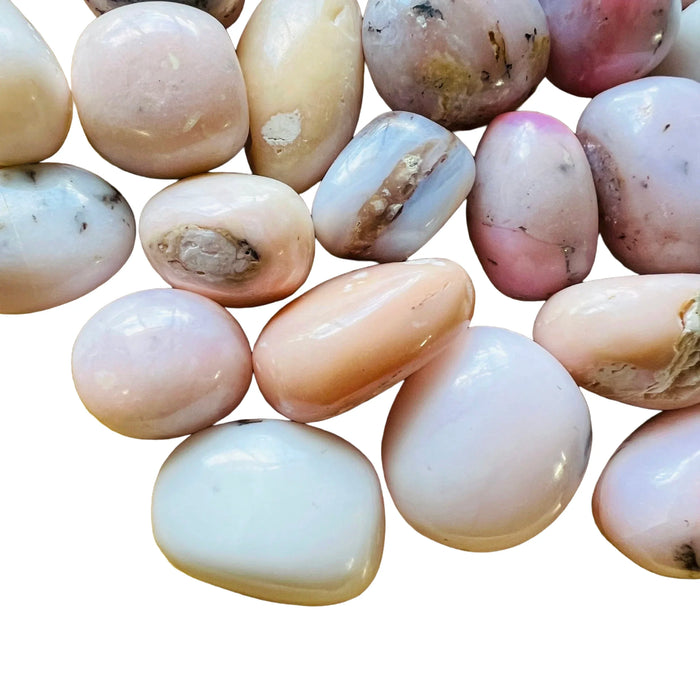
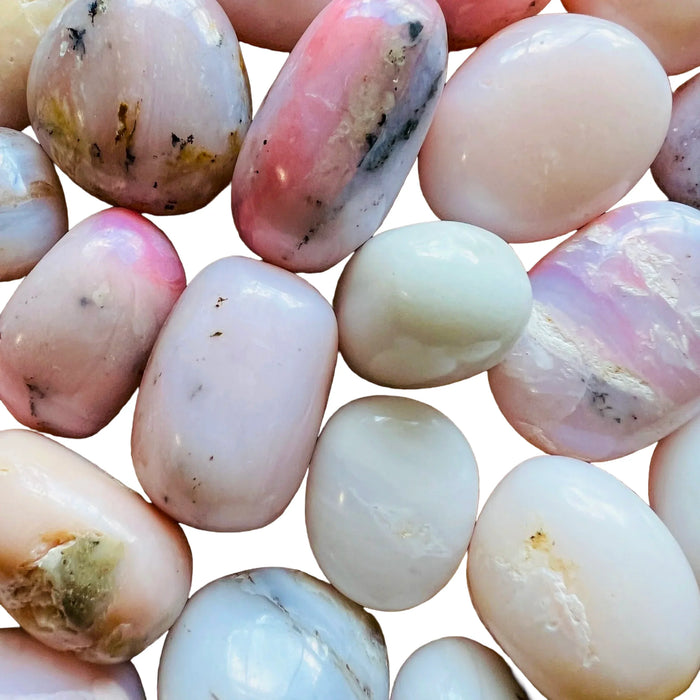
Real Peruvian Pink Opal shows natural color variation with subtle banding or patches of slightly different pink tones. Under strong light, thinner pieces are partially translucent. The polish reads waxy to vitreous. Unlike Welo Opal, Peruvian Pink Opal does not absorb water visibly; water-testing will not change its appearance. Hardness 5.5 to 6.5 will scratch with a steel blade but not with a fingernail.
Dyed chalcedony or dyed howlite sold as Pink Opal shows uniform saturated color, dye pooling in fractures, and a harder surface than real Pink Opal (chalcedony is 6.5 to 7). Glass imitations feel warmer and show bubbles. Reputable sellers confirm Peruvian origin and note any stabilization.
Care & handling.
Water safe for a brief rinse with warm water and a soft cloth. Skip long soaks, saltwater, and ultrasonic cleaners, which can stress the amorphous structure. Avoid sudden temperature changes, which can cause crazing (a network of fine cracks). Chemical cleaners and abrasive materials will damage the relatively soft surface.
Cleanse energetically with moonlight, sound, smoke, or by placing on selenite overnight. Never use salt or saltwater on Pink Opal. At 5.5 to 6.5 on the Mohs scale, it scratches easily against harder stones. Store in a small pouch on its own, in a stable-humidity environment. Very dry conditions over long periods can cause water loss and crazing.
Pairs well with.
Proof, not promises.
We measure our own sourcing across five dimensions. Supply chain, environmental footprint, artisan support, market integrity, and pricing. The number is honest, not perfect. Where we can do better, we say so.
A deeper look.
Extended geology, sourcing, authentication, history, varieties, and pricing, for when the quick guide isn't quite enough.
Extended geology
Pink Opal is a variety of common opal, amorphous hydrated silica (SiO₂·nH₂O). Unlike precious opal, which shows play-of-color from regular silica sphere stacking, common opal lacks that internal order and shows no spectral fire. The pink color in Peruvian Pink Opal comes primarily from trace palygorskite, a fibrous clay mineral (fuller's earth), along with some organic matter embedded in the silica during formation.
Water content runs 3 to 21 percent by weight, part of the stone's chemistry rather than surface moisture. Mohs hardness 5.5 to 6.5. Specific gravity 1.98 to 2.25 (notably light). Amorphous structure. Vitreous to waxy luster. Conchoidal to subconchoidal fracture. No cleavage. Pink Opal is slightly porous and can slowly absorb oils and fluids with extended contact.
Extended sourcing
Peru dominates the global Pink Opal market. The Andes of central Peru, particularly the Ancash, Ica, Lima, and San Patricio regions, produce essentially all commercial Pink Opal. Indigenous Andean communities have mined Pink Opal for centuries; modern commercial extraction developed in the mid-twentieth century as global trade opened.
Australia produces some pink common opal, primarily from Queensland (around Quilpie) and parts of New South Wales, but Australian opal production is overwhelmingly precious opal rather than pink common opal. Mexico (Jalisco) and Indonesia have small Pink Opal deposits, primarily collector-grade rather than commercial. For practical purposes in the small-shop market, Pink Opal means Peruvian Pink Opal.
Authentication and warning signs
Real Pink Opal shows natural color variation with subtle banding. Under strong light, thinner pieces transmit light partially. Hardness 5.5 to 6.5 scratches with a steel blade. The polish reads waxy to vitreous. Peruvian Pink Opal is NOT hydrophane (unlike Ethiopian Welo); water does not temporarily absorb into it or change its appearance. This distinguishes it from Ethiopian common opal varieties.
Dyed chalcedony is the main imitation; it shows uniform saturated pink, dye pooling in fractures, and harder surface. Dyed howlite is softer still but also shows uniform color. Glass imitations are warmer to touch. Ask for Peruvian origin specifically to distinguish from Ethiopian or other opals that have different care requirements.
Historical and cultural context
Pink Opal has documented Andean use going back to pre-Columbian times. Pre-Incan cultures (including Chavin, Paracas, Moche, Nasca, and Chimu) worked Pink Opal into ornaments, ceremonial objects, and offerings. Incan tradition considered Pink Opal a stone of Pachamama (Earth Mother) and used it in heart-centered ceremonial contexts.
The stone entered global commercial markets in the twentieth century as Peruvian trade developed. Before that, Pink Opal was largely unknown outside the Andean region. Contemporary metaphysical practice treats Pink Opal as a gentle heart-chakra stone, often framed as the quieter version of Rose Quartz with a similar but softer action. The Andean cultural significance adds depth to the contemporary associations.
Varieties and trade names
Peruvian Pink Opal: the standard commercial Pink Opal.
Andean Pink Opal: another common trade name, essentially synonymous.
Salmon Opal: trade name for saltier orange-pink Peruvian material.
Pink Potch: technical term for pink common opal without play-of-color.
Pastel Opal: occasional trade name for softer-colored Peruvian material.
Pricing reality
Tumbled Pink Opal: 3 to 10 dollars per piece. Small polished shapes and palm stones: 10 to 40 dollars. Larger polished freeforms and spheres: 25 to 150 dollars. Fine Peruvian Pink Opal with deep color saturation: 60 to 300 dollars. Exceptional carved pieces or very large specimens: 100 to 500+ dollars.
Value drivers: depth and evenness of pink color, translucency, absence of cracks or crazing, clean polish, and documented Peruvian origin. Warning signs: 'Pink Opal' with dye pooling or uniform saturation suggesting chalcedony substitute, pieces without origin detail, or material that's too hard for opal (likely dyed chalcedony).
Good sourcing is a practice, not a claim.
Nothing we sell is dyed chalcedony or glass imitation sold as Pink Opal. We source from Peru with documented origin and walk away from material that doesn't meet our standard, even when it costs us sales.
Bring pink-opal home.
Every piece we carry is photographed individually and listed with its own origin and treatment notes. What you see is what ships. Browse our Opal collection for related varieties.
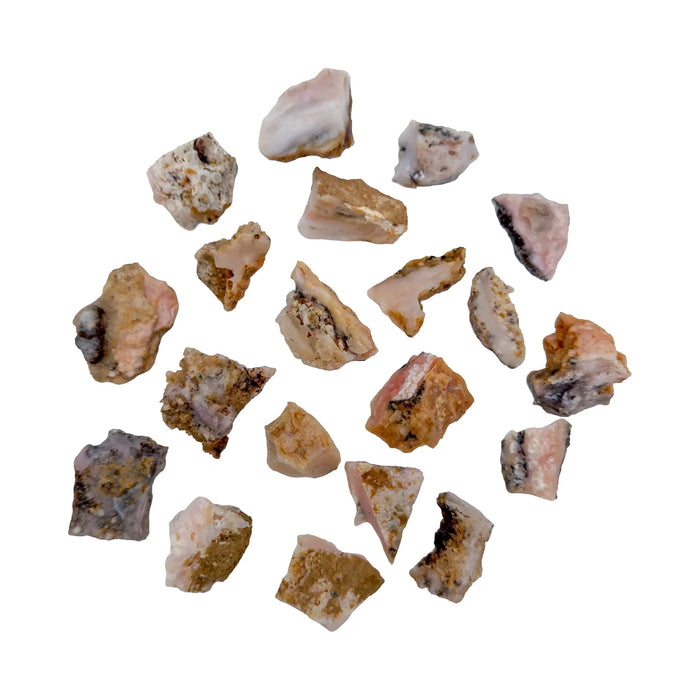
Shop the pink-opal collectionPink Opal, in stock now.
Our most-loved Pink Opal pieces, ready to ship.
- from 1,000+ reviews
- Ships within 72 hoursMonday to Friday, tracked
- 90 days to return itif you do not love it
- Free US shipping over $99$8.99 flat rate under
The Slow Note
New stones go to the list first.
No forwarding, no selling. Unsubscribe in one click. Privacy