























































What is Agate?
Agate Crystal Guide: meaning, origin & properties
Learn what Agate is, where ours comes from, traditional associations across cultures, and how to identify a real specimen, in our complete Agate Crystal Guide.


 Agatefor stress relief
 Amazonitefor stress relief
 Aquamarinefor serenity
 Aventurinefor luck
 Bloodstonefor energy
 Blue Kyanitefor confidence
 Blue Lace Agatefor stress relief
 Chrysocollafor emotional healing
 Fluoritefor focus
 Garnetfor energy
 Lepidolitefor stress relief
 Malachitefor emotional healing
 Moonstonefor grounding
 Obsidianfor protection
 Ocean Jasperfor emotional healing
 Red Jasperfor grounding
 Rhodonitefor emotional healing
 Selenitefor cleansing
 Sodalitefor focus
 Tiger Eyefor confidence


















Only 4 left in stock
Comes with a printed crystal card.


This is a natural agate candle holder from Minas Gerais, Brazil, cut from an agate nodule with a well drilled for a standard tea light. It stands 4 to 5 inches tall and 2.5 to 4 inches across, weighs 2 to 4 pounds, Mohs 6.5 to 7. The front face is polished to show the banding, the outer rind left natural.
This product has no reviews of its own yet. These are verified reviews of other Beyond Bohemian orders, not of this product.
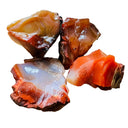
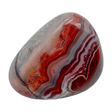
Agate is banded chalcedony, a microcrystalline quartz that fills cavities in volcanic rock in slow layers. Cut through and polished, each nodule shows a cream or white quartz center ringed by tan, rust, and gray bands, sometimes with a small open vug where the layers never closed.
These come from a cooperative in Minas Gerais, Brazil. The front face is polished flat, the outer rind is left rough exactly as it came out of the ground, and the base is cut so the piece stands on its own.
Worth knowing: a great deal of the agate sold today is dyed bright blue, pink, or green. These are undyed, and the colors you see are the colors the stone formed with.
Agate is traditionally a grounding, steadying stone, associated with stability and a settled mind rather than any dramatic shift. It is linked to the root and sacral chakras.
As a standing candle holder it sits at eye level where you notice it, which suits a stone people keep for steadiness. There is no single right way to use it.
These are traditional associations drawn from historical practice. This stone is not a substitute for medical or mental health care.
Offered as a starting point for your own practice.
Agate sits at 6.5-7 on the Mohs scale, about as hard as glass, so it handles daily use but will scratch against harder stones. Keep chemical cleaners away from it; they can etch the surface.
Natural agate from Minas Gerais, Brazil. No. Much of the agate on the market is dyed bright colors. These are undyed, so the cream, tan, and rust banding is natural to the stone.
You'll receive pieces from the same batch photographed, weighed to the amount you choose. Every piece passes our quality control and meets or exceeds what you see in the photos. Single specimens have their own product pages and say so.
Each piece measures 3.00-4.00" L x 2.50-3.50" W x 4.00-5.00" H and weighs 2 to 4 pounds.
Grades reflect visual quality within a batch. A is standard, with typical inclusions. AA shows stronger color, cleaner surfaces and tighter sizing. AAA is the top 10 to 15 percent of a batch. Every lot is inspected and graded by our team in Rockville, Maryland, not taken on the supplier’s word.
Minas Gerais, Brazil, cut and polished at a cooperative there. It came to us through a community partnership, one of the sourcing models we publish and stand behind.
Every lot is inspected and graded by our expert team before it goes on sale, not taken on the supplier's word. AA means high quality: stronger color, cleaner formation and a more refined finish. Pieces that miss the mark never reach the shop.
How We GradeSourced through a regional cooperative or community-based workshop. Processing and economic benefit stay local, which means more of the value reaches the people doing the work. We say what we know and where our tracing stops.
Our Sourcing StandardsEverything we sell is natural in origin: never synthetic, never dyed, never coated. Where a stone has been heated, irradiated or stabilized, which is common in the trade for some species, we say so on the product page. If a piece is not as described, return it within 90 days of delivery.
Returns and Guarantee