























































Multicolor Crystals Explained: Why One Stone Has Two or More Colors
A two-tone stone is not a defect, a dye job, or a fluke. It is a record of a changing environment.
Ametrine is purple at one end and gold at the other. Fluorite arrives in green, purple, and blue within a single crystal. Agate is a stack of stripes. Three very different stones, three very different reasons, and only one of them has anything to do with what a seller added.

A crystal shows more than one color for three reasons. Growth zoning, where the chemistry or temperature changed while the crystal grew. Banding, where layers were laid down in pulses. Or structural color, where no pigment exists at all and the stone is simply bending light. Added dye is a fourth possibility, and it looks different from all three.
Color Is a Record of Conditions, Not a Fixed Property
Most people meet a multicolor stone and assume one of two things: either it is a rare freak, or somebody tinted it. Usually neither is true. A crystal grows over a long stretch of time inside a changing environment, and its color is largely a running record of the conditions it grew in.
Fluorite makes this easy to see. It is calcium fluoride, which is colorless when pure. Every color it shows comes from trace impurities, from rare earth elements such as yttrium, and from defects in the crystal lattice caused by natural radiation. Those inputs are not constant. The fluid feeding the crystal changes temperature, pressure, and chemistry over and over, so the crystal writes those changes down in bands of green, purple, and blue.
That is why a single fluorite can be three colors while a single amethyst is usually one. It is not about the stone being special. It is about how much the conditions moved while it grew.

Raw Fluorite from Namibia. The green and purple sit inside the same crystals, because the fluid feeding them changed while they grew.
The Three Ways a Stone Ends Up Multicolored
Nearly every naturally multicolored stone on a shelf falls into one of these three. Knowing which one you are looking at tells you what the pattern means, whether it will hold up over time, and what it is reasonable to pay for.
Growth Zoning
The chemistry changed mid-growth
Rhythmic Banding
Layers deposited in pulses
Structural Color
No pigment involved at all
If you only remember one thing here, remember the tilt. Move the stone under a light. Colors that stay exactly where they are come from something inside the material. Colors that shift, flash, or disappear at certain angles are optical, and no amount of grinding would ever produce that pigment because there is none. Our guide to what gives crystals their color covers the chemistry side in more depth.
Ametrine Is One Crystal That Grew Under Two Conditions
Ametrine is the clearest teaching example of growth zoning we sell, and it is worth understanding because the explanation is genuinely surprising. Amethyst and citrine are both quartz. Both get their color from iron. The difference between purple and gold is not which element is present, it is what state that iron is in and what happened to it after it was locked into the crystal.
In the purple zones, iron sits in a state that was altered by natural radiation from the surrounding rock, which produces the color center we read as amethyst. In the golden zones, the iron ended up in a different arrangement associated with higher local temperatures, which reads as citrine. A single crystal growing across a temperature gradient can end up with both, side by side, divided along its own internal growth planes.
Commercial ametrine comes overwhelmingly from one place: the Anahi mine in eastern Bolivia, where quartz grew into cavities in dolomitic limestone. That is not marketing scarcity. It is a genuinely narrow set of geological conditions, which is worth separating from the manufactured kind of rarity we cover in what actually drives a crystal's price.
On natural ametrine the purple and gold meet along a straight or gently angled plane, because that plane is a growth face of the crystal. Color that fades softly across a stone in a gradient, with no structural boundary, is worth a second look. Synthetic bicolor quartz and heat-zoned material both exist, and honest sellers say so.
Every Band in an Agate Is a Separate Event

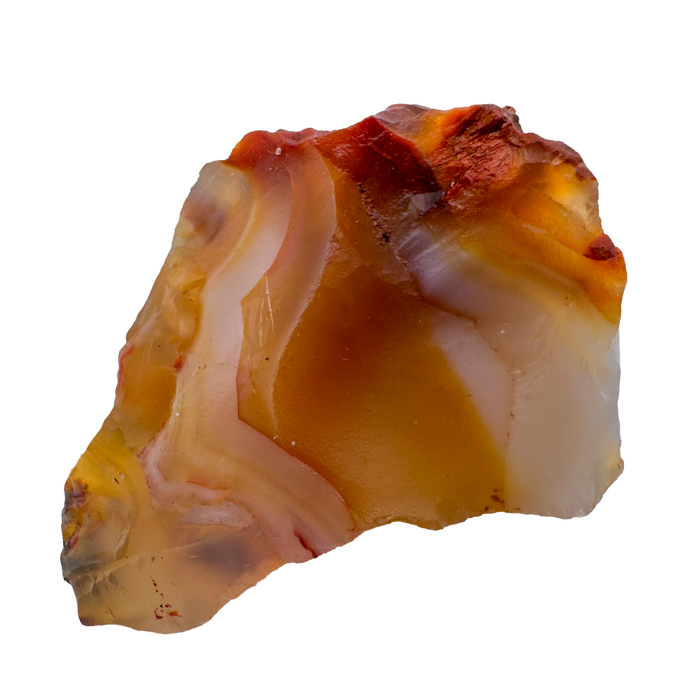
A cut agate reads outside-in. Each band marks a pulse of silica-rich fluid entering the cavity, carrying its own chemistry.
Agate forms when silica-rich fluid moves into an open space, most often a gas bubble or a cavity in volcanic rock, and deposits chalcedony against the walls. It does not do this in one pour. It does it in pulses, and each pulse arrives with its own trace chemistry and oxidation state.
That is why the colors repeat but never repeat identically. Iron oxides give the reds and oranges, manganese contributes toward blues and purples, chlorite pushes green. The bands are not decorative. They are a stratigraphic record of the fluid that filled the void, read from the outside wall inward.
Malachite bands for the same structural reason, forming in rounded botryoidal layers as copper-bearing solutions deposit carbonate. Chevron Amethyst does it in straight v-shaped stripes where purple amethyst growth alternated with white quartz. Different minerals, same underlying story: the environment pulsed, and the stone kept score.
Some Multicolor Is Pure Optics
Labradorite is the stone that catches most people out. Hold it still and it is an unremarkable gray. Tilt it and a sheet of blue, green, or gold sweeps across the surface. Nothing in that flash is a pigment. Labradorite contains microscopic alternating layers of two feldspar compositions, and light interfering across those layers cancels some wavelengths and reinforces others. The effect has its own name, labradorescence.
Precious opal does something related but distinct. It is built from tiny silica spheres packed in a regular three-dimensional array, and light diffracts around them. Sphere size determines which colors appear, with smaller spheres producing blues and greens and larger ones producing reds. That is why the color moves as you move, and why no two opals are patterned alike.
The rainbows inside a clear quartz point work on the same principle at a larger scale. They are almost always healed internal fractures. The thin film where the fracture partly re-sealed splits light into a spectrum, which is thin-film interference rather than an inclusion. Named inclusions are a separate subject, covered in our guide to what is actually inside your quartz.

Labradorite from Madagascar. The blue is not in the mineral, it is in the way light bounces between microscopic internal layers.
"Pigment color sits still. Structural color moves. That one difference sorts half the shelf."
The Multicolor Stones You Are Most Likely to Meet
These are the ones that come up again and again. The mechanism column is the useful part, because it tells you what to expect from the stone: whether the pattern is structural and permanent, or optical and angle-dependent.
| Stone | Colors | Mechanism | What to check |
|---|---|---|---|
| Ametrine | Purple and golden yellow | Growth zoning in quartz, iron in two different states | A defined boundary along a growth plane, not a soft gradient |
| Fluorite | Green, purple, blue, clear, sometimes yellow | Growth zoning from shifting trace elements and lattice defects | Bands aligned with the cubic structure. Fluorite is soft at Mohs 4 |
| Watermelon Tourmaline | Pink core, pale ring, green rim | Concentric growth zoning in elbaite as the chemistry changed | Zones concentric around the crystal axis, visible in cross section |
| Agate | Nearly any, in repeating bands | Rhythmic banding from pulsed silica deposition | Neon pinks, electric blues, and hot purples usually mean dye |
| Malachite | Light and dark green bands | Rhythmic banding in rounded botryoidal layers | Bands should curve. Perfectly straight stripes suggest reconstituted material |
| Chevron Amethyst | Purple and white | Alternating amethyst and milky quartz growth | Sharp v-shaped or straight banding, not a wash of color |
| Labradorite | Gray body with blue, green, gold flash | Structural, light interference across internal feldspar layers | The flash must move as you tilt. A static painted-on sheen is not labradorescence |
| Precious Opal | Shifting spectral flashes | Structural, diffraction off packed silica spheres | Color should change with viewing angle. Opalite is unrelated man-made glass |
| Rainbow Quartz | Internal spectral sheets in clear quartz | Structural, thin-film interference in healed internal fractures | Rainbows sit inside the stone. Surface-wide iridescence means a metallic coating |
Two-color stones are not automatically worth more than one-color stones. In gem-quality ametrine the cut matters enormously, because a lapidary has to orient the rough so both zones show in the finished stone with a clean division. That work, rather than the multicolor itself, is what is being paid for.
For a rough or tumbled piece, judge it the way you would judge anything else. Look at the saturation of each color, whether the boundary is crisp, and whether the piece is free of chips. Multicolor is a characteristic, not a grade.

Tumbled Ametrine from Bolivia. Even in a tumbled piece, the two zones stay divided along the crystal's original growth planes.
When the Second Color Was Added
Natural multicolor has competition. Dyed and coated stones are common, they are legal, and they are perfectly fine when disclosed. The problem is only ever the silence. Here is what separates added color from grown color.
Grown color follows growth planes and bands. Dye follows porosity and cracks, so it pools darker in fractures and along the softer, more absorbent layers of an agate. If the color map and the structure map disagree, the color was added.
Agate genuinely comes in a wide range. It does not come in fluorescent magenta, electric teal, or candy blue. A whole tray of bright, evenly matched slices in unnatural colors is a dyed batch, not a lucky find.
Aura quartz gets its metallic rainbow from a vapor-deposited metal film on the surface. Look at where the color lives. Coating sits on the outside and often stops at a break. Real internal rainbows sit within the stone.
Natural zoning and banding vary piece to piece because the conditions varied. Twenty stones with identical color placement came out of the same process, not the same pocket.
We cover each of these in depth rather than repeating them here: how to tell if a stone is dyed, what aura and flame coatings actually are, and the man-made glass sold as crystal. None of these treatments is a scandal in itself. What matters is whether you were told.
Related Guides
The chemistry underneath all of this: chromophores, color centers, and which colors last.
Understand colorRutile, phantoms, chlorite, and the rainbows that come from healed fractures.
Look insideColor in the cracks, colors that do not occur, and the acetone test done carefully.
Read the field guideAgate, jasper, amethyst, and citrine are all one mineral family. Here is the map.
Meet the familyThe most reliably multicolor mineral on the shelf, and where ours is mined.
Explore fluoriteOur full collection of trust-first crystal guides and comparisons.
Browse the LibraryFrequently Asked
Why does my crystal have two different colors?
Almost always because the conditions changed while it was growing. Crystals form over long periods, and the temperature, pressure, and trace element supply in the surrounding fluid can shift many times. Each shift can change the color being produced, so the finished crystal preserves those changes as zones or bands.
Is a multicolored crystal natural or dyed?
Both exist, and the difference is usually visible. Natural color follows the crystal's structure, so zones align with growth planes and bands run parallel to the cavity wall. Dye follows porosity instead, pooling darker in cracks and in the more absorbent layers. Colors that do not occur in nature, such as neon pink or electric teal agate, are dyed.
What is ametrine and is it real?
Ametrine is a natural quartz that contains both amethyst and citrine zones in one crystal. Both colors come from iron, in different states, produced by a temperature gradient across the growing crystal. Commercial ametrine comes overwhelmingly from the Anahi mine in eastern Bolivia. Synthetic bicolor quartz also exists, so buy from sellers who state origin and treatment.
Why is fluorite so many colors at once?
Pure fluorite is colorless calcium fluoride. Its colors come from trace impurities, rare earth elements such as yttrium, and defects in the crystal lattice created by natural radiation. Those inputs changed repeatedly while the crystal grew, so a single specimen can carry green, purple, blue, and clear zones aligned with its cubic structure.
What makes the bands in an agate?
Silica-rich fluid entering a cavity in pulses rather than all at once. Each pulse deposits a layer of chalcedony carrying slightly different trace chemistry, which produces a slightly different color. Iron oxides account for reds and oranges, manganese for blues and purples, chlorite for greens. The bands are read from the outer wall inward.
Why does labradorite change color when I move it?
Because that color is not a pigment. Labradorite contains microscopic alternating layers of two feldspar compositions, and light interfering across those layers reinforces some wavelengths and cancels others. The effect is called labradorescence, and it appears only at certain viewing angles, which is why the flash sweeps across the stone as you tilt it.
What causes rainbows inside clear quartz?
Usually a healed internal fracture. The crystal cracked while it was still growing, then partly resealed, leaving an extremely thin film along the old break. Light splits into a spectrum across that film, which is thin-film interference. It is a structural effect rather than an inclusion, and it sits inside the stone rather than on the surface.
Are multicolor crystals worth more?
Not automatically. In cut gem material a strong two-color stone can carry a premium, largely because orienting the rough so both zones show cleanly is skilled work. For rough and tumbled pieces, judge saturation, how crisp the boundary is, and condition, the same way you would judge any stone. Multicolor is a characteristic rather than a grade.
Will a multicolored crystal fade?
It depends on which color, not on how many. Colors produced by radiation-created color centers, including the purple in amethyst and ametrine and many fluorite colors, can weaken with long, direct sun exposure. Colors from essential elements, such as the copper green in malachite, are far more stable. Display multicolor pieces out of direct sunlight to be safe.