










Why Is Rhodonite Pink and Black? The Geology of Manganese

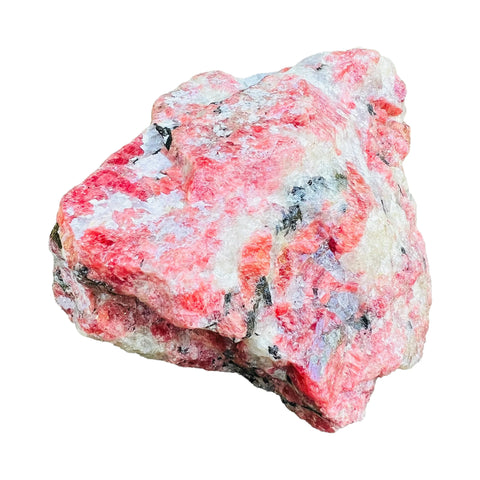
Rhodonite is easy to spot once you know it. Rose-pink stone, webbed with black, like a garden overrun with dark vines. It turns up as tumbled stones, palm stones, and polished hearts, and it is one of the few pinks in the mineral world that owes its color to a single element.
Rhodonite is a manganese silicate. The manganese gives it a rose-pink color, and the black webbing is manganese oxide that forms as the stone weathers over time. It is harder than rhodochrosite, the softer pink carbonate it often gets confused with. Look for the pink-and-black pattern and a firm, glassy feel.
That element is manganese. Here is what it does, how the black veining forms, and how to tell real rhodonite from the softer stone it often gets confused with.
What rhodonite actually is
Rhodonite is a manganese silicate, with the formula (Mn, Fe, Mg, Ca)SiO3. It belongs to the pyroxenoid group and crystallizes in the triclinic system, though clean single crystals are rare. Most of what you will hold is the massive form: solid, carveable, and marbled with black.
On the Mohs scale it runs 5.5 to 6.5, close to the hardness of a steel blade. That firmness is part of why it takes a warm, glassy polish and holds up well as a palm stone or a heart you carry every day.
Why it is pink, and why the black
The pink comes straight from manganese. Inside the crystal structure, manganese absorbs certain wavelengths of light and leaves behind the rose-to-red color your eye reads. The more manganese, the deeper the pink.
The black is a separate story. Those veins and patches are manganese oxide, which forms as the stone sits near the surface and weathers over long stretches of time. Air and water work into tiny cracks, the manganese oxidizes, and dark webbing spreads through the pink. Every piece weathers on its own schedule, so no two patterns are exactly alike. The black is not a flaw or a filler. It is the same metal as the pink, in a different, oxidized form.
Rhodonite vs rhodochrosite: the mix-up
These two get swapped constantly, and the names do not help. Both are pink, both are manganese minerals, and both begin with “rhodo,” from the Greek word for rose. But they are built differently, and once you know the tells, they are easy to keep apart.
| Feature | Rhodonite | Rhodochrosite |
|---|---|---|
| Mineral type | Manganese silicate | Manganese carbonate |
| Hardness (Mohs) | 5.5 to 6.5 (firm) | 3.5 to 4 (soft) |
| Signature look | Pink with black veining | Vivid pink with white banding |
| Typical form | Massive, carved into shapes | Bands and stalactite slices |
| Where it forms | Metamorphic rock | Hydrothermal veins |
The quick tell: rhodonite is harder and usually carries black manganese-oxide veining. Rhodochrosite is softer, often more vivid, and tends to show white or pale banding rather than black. If a “rhodonite” is banded in white with no dark web, or if it scratches easily, there is a good chance it is rhodochrosite wearing the wrong name.
Where it forms, and where ours comes from
Rhodonite grows where manganese-rich rock gets heated and squeezed. Metamorphism and hot mineral fluids concentrate the manganese, and the stone develops in the reworked deposit. Classic sources include the Ural Mountains of Russia, along with Australia, Brazil, Peru, and Sweden. The rhodonite we carry comes from Madagascar, Mozambique, Peru, and Zimbabwe.
Because it is a rock-forming mineral rather than a single perfect crystal, rhodonite is usually cut from larger masses. That is why you see it as palm stones, hearts, and free forms instead of points. If you want the fuller picture of how a stone travels from deposit to your hand, our sourcing standards lay out what we ask before a piece earns a place in the shop.
How to tell you have the real thing
- Look for the black web. Real rhodonite usually shows black manganese-oxide veining running through the pink. Evenly bright pink with no variation at all is worth a second look.
- Test the hardness. At Mohs 5.5 to 6.5, rhodonite resists a steel blade. If it scratches easily, it may be softer rhodochrosite or a dyed stand-in.
- Check the pink for dye. Uniform, candy-bright color that pools in cracks can point to dyeing. Natural rhodonite pink is warm and a little uneven.
- Ask for the origin. A seller who knows where a stone came from can usually tell you what it is. If no one can name either, slow down.
Rhodonite is a good reminder that color in a stone is rarely just decoration. The pink and the black are the same metal, told in two forms, written over a very long time. If you want to see how much the pattern shifts from piece to piece, our rhodonite collection shows the range, and our crystal guide covers more of the stones people mix up. If you have ever weighed it against another pink stone, our look at rose quartz and rhodonite is a good next read.
Color in a stone is rarely just decoration. Rhodonite’s pink and its black veining are the same manganese in two forms, and a seller who can name where a piece came from can usually tell you exactly what you are holding.
Question about a specific piece? Just ask. We would rather tell you exactly what you are holding than let a pretty name do the talking.