

































































Labradorite is sold on its flash, and a photo shows one angle of it. Here are the four checks that separate a good piece from an ordinary one, what A, AA, and AAA mean for this stone, and why ours comes from Atsimo-Andrefana, Madagascar.
How to Buy Labradorite: Flash, Grade, Cut, and Madagascar Origin

You have three tabs open. Each one says labradorite, each one shows a stone lit blue from edge to edge, and the prices run from four dollars to forty. Not one of the three tells you what the piece will look like sitting on your desk at noon.
Quick answer
Labradorite is priced on its flash, not on the mineral, and a photograph shows exactly one angle of it. Before you buy, check four things: how much of the face the flash covers, how wide the tilt window is, whether the cutter oriented the piece to the flash layers, and the condition of the surface. Then ask the seller one question: which region. Ours comes from Atsimo-Andrefana, Madagascar.
Maybe you bought a piece that arrived gray and stayed gray. Maybe you paid AAA money for a stone that flashes from one narrow angle and nowhere else. Maybe you want to know whether the word rainbow on a listing means anything at all. Any of those, this guide is for you.
Mineral family
Plagioclase feldspar
Hardness
Mohs 6 to 6.5
Graded on
Flash coverage and strength
Our source
Atsimo-Andrefana, Madagascar
Hold it still and it is gray
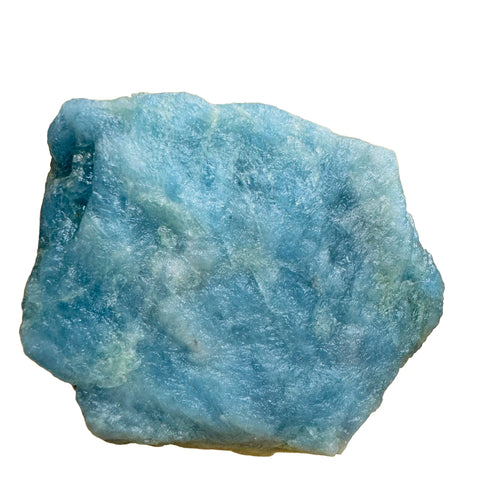
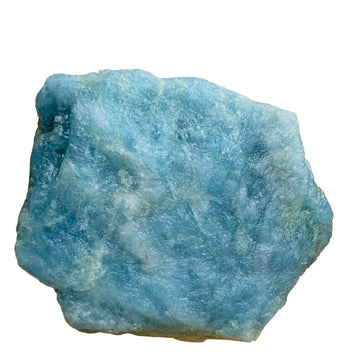
Set a raw piece flat on a table under an overhead light and it reads as a dull gray rock with a faint green cast. Nothing about it suggests the blue. Pick it up, turn it a few degrees toward a window, and a sheet of color crosses the whole face at once and is gone again just as fast. That is the part that confuses first-time buyers, and it should. It also explains why the same stone can look like two different stones in two different listings.

The effect has its own name, labradorescence, taken from the Labrador coast of Canada where the stone was first described in the 1770s. It is not a dye, a coating, or a treatment of any kind. We wrote up the full geology, the exsolution layers and the light interference, in why labradorite flashes. This guide starts where that one stops: how to tell a good piece from an ordinary one before money changes hands.
The spacing sets the color, and blue is the common one
The short physics is this. Labradorite is a plagioclase feldspar, a blend of a sodium-rich and a calcium-rich end member. As the magma cooled, those two components pulled apart into alternating bands inside the same crystal, a structure geologists call the Boggild intergrowth. The bands run roughly 130 to 250 nanometers thick. Visible light runs about 400 to 700 nanometers, so the bands are on the same scale as the light hitting them, and slightly smaller. Reflections off neighboring bands interfere, some wavelengths cancel, and others come back much brighter than they went in.
Which color you get is set by how thick the bands happen to be. Thinner spacing reinforces the shorter wavelengths, which is blue. Wider spacing pushes the reinforced band toward green, then gold, then orange and purple at the far end. The conditions that produce blue-range spacing are far more common in nature than the ones producing the wide end, which is why blue is the standard flash and strong gold or purple is the exception.
A piece that throws several colors from different angles has patches of differing band thickness in the same stone. That is where the trade term rainbow comes from, and unlike a lot of trade terms it describes something physically real.
Here is what that means for your wallet. You are never paying more for a rarer mineral. Labradorite is labradorite. You are paying for a spacing accident that happened once, underground, and cannot be reproduced. So we sort our rough under a single light into blue predominant, rainbow, orange and gold predominant, and purple predominant, and we grade each lot on how strong and how broad the flash is, not on which color it throws. An A-grade gold piece and an AAA blue piece are the same feldspar. The letters describe the flash.
Why so much of it comes from Madagascar
Labradorite occurs in mafic intrusive rocks, meaning bodies of magma rich in iron and magnesium that cooled slowly at depth rather than erupting. Slow is the operative word. A lava flow that chills at the surface freezes the feldspar before the bands can separate, and you get no flash at all.
Madagascar's geology is unusually generous here. The island carries large exposures of ancient basement rock from the time it was joined to Africa and India, including the gabbro and anorthosite bodies that host good labradorite. Deep tropical weathering has since broken down the softer surrounding material, which frees the harder feldspar and concentrates it where it can be worked without heavy machinery. We covered the wider picture in why one island punches above its weight.
That last point matters more than it sounds. Much of the labradorite reaching the market is recovered by small teams working shallow ground by hand, then cut and finished locally. Ours comes from Atsimo-Andrefana, the southwestern region of the island, through a community partnership, and it is cut, tumbled, or hand-polished there before it ships. We ask which region. We ask who sorted it under the light. We ask what was done to the surface before it left. The answers are written out on the Beyond Ethical sourcing page, including what we can verify and what we cannot, and the five sourcing paths we use are on from the source to you.
The four checks before you buy
Photographs are close to useless for labradorite, and honest sellers will tell you so. A single still image captures one angle, which is exactly the variable the effect depends on. A stone can be photographed at its best moment and look ordinary in the hand, or the reverse. So check these four things instead of the photo.
| Check | What to look for | What it tells you |
|---|---|---|
| Coverage | Does the flash cross the full face, or only a corner? | The single biggest driver of what a piece is worth. Full-face flash on raw material is genuinely less common than partial. |
| Angle window | Tilt slowly through a wide arc. How many degrees does the flash survive? | A wide window is the more pleasant stone to own, because it does not have to be posed. |
| Cut orientation | On polished pieces, does the flash sit across the broad face or hide on an edge? | Whether the cutter read the stone. The same rough cut against the layers yields a dull piece. |
| Surface condition | Edge chips on raw pieces, chips or scratches across a polished face. | Raw edge chips are normal and do not touch the flash. Chips across a polished face do. |
Coverage. The first thing to check, and the one grade letters are trying to describe. Grading language across the trade is not standardized, so ask what a given grade means to that seller. For ours, AAA takes the strongest and broadest flash in a lot, AA is where most of the catalog sits, and A means the flash is there and you will have to find it. We explain how we calibrate the letters in crystal grades explained.

The angle window. Some pieces flash across a wide range of tilt. Others need one narrow position and go gray everywhere else. You cannot read this from a photo at all, which is why a short video beats any still.
Orientation of the cut. The bands sit in a specific plane inside the crystal. A cutter who orients a palm stone or a heart parallel to that plane gets flash across the broad face. Cut against it and the same rough yields a dull piece. On polished labradorite you are partly buying the cutter's judgment, not just the rock.
Surface condition. Feldspar has two good cleavage directions and sits around 6 to 6.5 on the Mohs scale, which is softer than quartz. It chips along those planes if handled carelessly. Small edge chips on a raw piece are normal and do not affect the flash. Chips across a polished face do.
The Three-Line Test
A listing should tell you form, origin, and treatment in three lines. If one is missing, that is the one being hidden. For labradorite the treatment line is short, because the stone needs none, so the line to watch is origin. If a listing says Madagascar and stops, that is a country, not a region.
A worked example, at our prices as of this writing. A one-pound lot of AA rainbow rough at 1.50 to 2.50 inches is 8 to 12 pieces for $40, which is $3.33 to $5.00 a piece. A single AAA blue-predominant piece at 0.75 to 1.50 inches is $5.00. The per-piece price barely moves between the two. What moves is the trade you are making: size and color range on one side, coverage and strength of a single color on the other. Neither is the wrong choice. They are different stones for different shelves.
If you want the fuller reference, including the mineral data and what we hold, it is in the labradorite crystal guide, and the pieces we currently carry are in the labradorite collection.
The part people ask about last
Labradorite has a long association with intuition, transition, and protection during change, and that reputation is old enough to be worth mentioning honestly rather than dismissing. We would only point out that the association fits the stone's behavior rather neatly. It looks like nothing until you move, and then it shows you something that was there the whole time. Whether that is meaningful to you is your call, not ours to make.
What we can say without qualification is the geology. The flash is real, it is structural, and no one added it.
Common questions
Is labradorite dyed or coated?
No. The flash is caused by the internal band structure and needs no treatment. Be aware that some material sold as labradorite in very saturated single colors may be a different stone entirely, so ask what the mineral actually is.
What does AAA mean for labradorite?
There is no industry standard, so the letters only compare lots within one shop. In our catalog AAA is the strongest and broadest flash in a lot, AA is above average and where most of our labradorite sits, and A means the flash is present but partial. The grade describes the flash, not the color.
What is the difference between labradorite and spectrolite?
Spectrolite is a trade name for labradorite from a specific Finnish deposit that tends to show flash across a broad range of colors. It is the same mineral, named for where it came from and how it performs.
Why does my piece look gray in photos?
Because a photo fixes one angle. Labradorescence is directional by nature. This is normal and not a sign of a poor stone.
Can labradorite go in water?
Brief contact is not a problem, but feldspar is softer than quartz and has cleavage planes, so prolonged soaking and rough handling are worth avoiding. Wipe it dry rather than leaving it wet.
Does the flash fade over time?
No. The band structure is part of the crystal. A dulled appearance is almost always surface film or scratching on a polished face, not a change in the effect itself.
One thing to do before you buy
Before your next labradorite purchase anywhere, ours included, ask the seller for ten seconds of video tilting the piece under one ordinary lamp. A still photo shows one angle. Ten seconds shows the stone.